Nothingness is a huge part of everything

I ramble on a lot. I edit a lot, too, hard as that might be to believe, tossing out about 7 or 8 words for every one that I leave. Yes, I know, anything less than a 10:1 scrub ratio marks me as an amateur too in love with his darlings....

Mary Ann Reilly and I have never met, though we have collaborated on a project I tossed at our state  Ed Commissioner Christopher Cerf--ain't the internet grand? She's building a high school, one I'd like to be part of, but enough of the full disclosure nonsense.


I wrote this: "The atoms taught in elementary school  do not exist. If a nucleus is the size of a dime, the electrons would fling as far as half a football field, and even that's just an average. What's in-between? Nothing. Nothingness is a huge part of everything."

She wrote that: "Nothingness is a huge part of everything and there is never the accounting for nothingness in the slick state and now national standards. They are overfilled with their own self importance."

The national standards are like our universe 14.6 billion years ago--no space, no wiggle room, no humanity.

Life found in the spaces, in the niches, in the shadows of the corners works the same way as the stuff that spews forth in the elevated air of Mount Hubris. And matters just as much.

Thank you, Mary Ann, for helping me see this.


Mary Ann Reilly is an artist who is fascinated by edges, by borderlands.
The photo is by her, used without permission.


READ MORE - Nothingness is a huge part of everything

Student Loans – Pay For Your Education Easily

Education is everything in today's world. Time when people got jobs based on their work skill are long gone. To be employed you first have to show your employer your education qualifications. Finding a good education is extremely important. But a good education is also an expensive one. You do not need to worry about being able to afford one anymore as student loans strive to give you all the funds you would need to pay for your education. Whatever the course you pick may be, the funds from this advance can pay for it.
student loans are the way out of the finance problems that you have that prevent you from getting the education you deserve. Students are at the liberty to choose an amount from the secured or unsecured category. Each of these provides varying amounts, repayment periods and interest rates, the secured form requires collateral whereas the unsecured form does not. The funds are large enough to provide for an entire year of your studies until you can find another means to finance it. There is no longer a reason why you should deprive yourself of what you want to do.
Tuition fee, examination charges, expenses incurred on books, laboratory and computer fees can be paid for with the money applicants procure from these funds. Being student loans, the interest rates are also low, making them easy to repay. A bad credit score should not hold you back anymore. There are no credit checks done and so debts, CCJs and so on are ignored. You can choose a plan the best suits you from student loans and hence benefit from it in every way.
With student loans you can fund your higher education without any worries. You can apply for this advance online. Funds will be sent to your bank account instantaneously and by educating yourself you can continue to pursue the bright future you always dream of for yourself. Waste no more time and then no more. If you have a shortage of funds, apply today.
READ MORE - Student Loans – Pay For Your Education Easily

Guest Post - On Teaching Children How to Learn

On Teaching Children How to Learn

Guest Post by Jeremy Fordham


There is perhaps no single greater challenge in parenting than teaching your child how to learn, and this is a process that requires nurturing an appreciation for the acquisition of knowledge. It requires pushing a child to enjoy challenging his or herself, to see “boring” subjects from interesting angles, to convince themselves to take an active role in their own education. Professionals have lots of opinions on why children lose interest in education as they grow older, but in the United states almost a quarter of college graduates are going on to pursue advanced degrees in a gamut of PhD programs, indicating that parents are definitely doing something right these days when it comes to instilling a life-long interest in learning. But just what exactly does it take? How can we increase the number of kids maintaining long-term interest in school? Or, at the very least, how can we maintain a long-term interest in learning no matter what a child’s ultimate decisions end up being? The trick is to start setting strong work ethics early on in life.

Preschool

Preschool doesn’t have to be a $30,000-a-year affair with entrance examinations and headaches in order for your child to get the most out of the experience. A very interesting study recently published in Science does a great job of quantitatively demonstrating the benefits of preschool. As highlighted and dissected by MotherJones, students who attended preschool, according to the study, had stronger high school graduate rates, higher college attendance statistics and had higher overall incomes compared to their non-preschool-attending peers. And while correlation is certainly not causation, myriad professionals have exhaustively addressed the importance of preschool in early childhood development.

There are innumerable reasons why preschool is so important when it comes to teaching children how to learn. According to Berkeley professor David Kirp, preschool comes at a time when children are in a crucial developmental stage
. By placing a child in an environment where they can interact socially, hear words, build relationships with peers and exercise their sponge-like brains, kids hone life-long skills that make it easier to learn and succeed further on down the road. Preparation for the emotional and psychological aspects of education is one of the most important foundations necessary for developing strong study skills and learning habits.
At such an early stage of life, “instilling a strong interest in learning” seems like an elusive and impossible concept. But think about how easy it really is. Imagine if a preschooler is encouraged to figure out basic puzzles, or pushed to interact with the sounds that resonate from a piano when they touch the keys. In the most basic and most fundamental way possible, inspiring this sort of exploration at a young stage exposes children to the process of learning. Yes, it is difficult; yes, it requires motivation. But this is what makes it fun. It is entertaining to use your hands and figure out how a system works, and the more that a young child is exposed to that eureka! feeling, the more likely they are to pursue more of those moments as they grow older.

Furthermore, preschool helps bridge the gap in learning created by unavoidable socioeconomic stratification. According to Mr. Kirp, by age four children from a family dependent on welfare will have heard 30 million fewer words than those who come from middle class homes. This inherently dooms disadvantaged children to fall behind if parents do not act early on. Preschool is one of the greatest ways of ensuring that children are exposed to other minds like their own; of ensuring that they develop the critical keystone of their educational apparatus upon which they build as they grow older and are exposed to more external stimuli. Preschool is widely available and is a great way to start a child off on the right foot.

Parental Involvement

While preschool is a great way to develop the precursors of strong study skills, it should by no means be seen as a substitute for parental involvement in the educational process. The importance of familial connection and the organic benefits provided by parent-child interaction are unparalleled. There are a lot of interesting opinions on what makes a great parent, but the truth is that there is no unanimous answer to this question. Every child is born in unique circumstances that, very often, require variations in how parents need to approach learning. And no, stressing that a child performs at superior standards in school is not what is meant by an “approach to learning.”

Children need to be engaged by their parents in ways that promote critical self-reflection, as well as a reflection of the external world. Reading to a child, discussing current events, formulating opinions with them, inspiring structured (but simple) arguments, going on walks and asking questions about natural things--this is the type of organic interaction that encourages an a life-long interest in general education. Always remember that nobody is perfect--part of learning how to study well and retain information efficiently is learning how to do it incorrectly. Failure is an integral part of the learning process. All of the world’s greatest scientists didn’t formulate their theories overnight, and similarly, your child won’t become a great learner by asking just one question. Allowing children to develop their own unique interests, allowing them to pursue hobbies, ask questions and explore answers (within boundaries, of course), is one of the surest ways to help them figure out the right way to take in information--the right way for them. A strong natural inquiry translates into strong study habits, especially if a child has spent a lot of his or her time practicing in real, applicable ways that appease their own unique curiosity.

Additional Strategies

There are lots of different, existing strategies that a parent can take to help develop good study habits in children, especially when they’re older. Jennifer Viemont, a college success consultant of Deliberate Living, stresses the importance of concepts like time management and seeking outside help, which are somewhat complex ideas that are often best learned through trial and error.
Especially in today’s technology-laden world, time management seems to the bane of many teenagers’ existences. Lots of parents see their children complain that there just aren’t enough hours in the day!, only to see their teenager collapse in front of the TV or jump onto Facebook when they get home from school. In actuality, establishing a homework routine with an eight-year-old is much easier than with a teenager for obvious reasons rooted in psychological malleability. Teaching a child how to keep a calendar, budget time devoted to specific tasks, when to hang in there and when to call it quits are all essential in ensuring both educational success and general achievement as a working citizen. But these habits need to be ingrained early on if they are to effectively take hood. One of the largest blocks of successful studying and learning is emotional stress, and teaching children how to avoid this pitfall will boost their likelihood for success exponentially.

At the end of the day, developing study skills and lifelong learning habits is a complex process that involves delicate coordination of many ideas at many stages in a child’s life. A stepwise, knowledgeable approach to this ideology, however, has inevitable positive influence that, when combined with a little love, is sure to make your child an inquisitive person who not only enjoy new discovery, but who actively seeks it out.


Jeremy Fordham is a writer who assesses and promotes virtual PhD programs. He is an engineer who hopes to inspire dialogue in unique niches by addressing topics at the intersection of many disciplines.


READ MORE - Guest Post - On Teaching Children How to Learn

Teacher Grade-ins - what a great idea to show the public what we do


I learned about teacher "grade-ins" from the CT Education Association blog (affiliate of NEA). The article talked about how New Jersey teachers came up with this idea and now it has spread to other states including my home state of Connecticut.

A grade-in when a group of teachers gather in a public space, like a park, shopping mall, or store (like a bookstore with a cafe), and grade papers and prepare lesson plans, in the evening or on weekends.

These grade-in's show the public what teachers do when they are not in school. The reaction from teachers and the public has been very positive. Unless you are a teacher, a room mate of a teacher, or have a teacher in your family, you probably think teachers work 7 hrs a day and get all these days off and the summer off. These grade-in's are showing the public how much work teachers do outside of school. I know that I work in the evening, on weekends, and even on "vacations" just like most of my colleagues. Reports from teachers participating have said that the public is responding well, and in some cases surprised, about how much extra work teachers do.

I think that this is a great idea. Besides showing the public what we do, it would also create more of a community with the teachers themselves instead of working at home in isolation. Make it social and productive. Create a wonderful new Professional Learning Community.

What do you think about this idea?


Resource:
http://blogcea.org/2011/06/13/grade-ins/


READ MORE - Teacher Grade-ins - what a great idea to show the public what we do

Student Loans For Bad Credit – Easy Way To Finance Your Education

Student life if full of desires and most of such desires are directly or indirectly related to their future. But to accomplish what they want they require a lot of money. It is not necessary that their parents are fully capable to help them to fulfill their all needs. In such situations, they feel much stressed out. But now we have find out the solution to all their problems. Student loans for bad credit are the best option for such people.
With student loans for bad credit you can avail loan and can get your dreams come true very easily. These help the borrowers to accomplish all types of this education related needs in time. The best thing abut such loans is that, lenders don't go for any kind of credit checks for these kinds of borrowers. They may simply issue these loans to you without any kind of consideration or other formalities. In most of the cases, the loan is approved within few hours of applying for the same.
Moreover the lenders issue these loans in the both forms as per the needs of the borrowers. You may take these loans in the secured as well as unsecured manner. For the secured form, you need to offer any security and these loans are for long term purpose. On the other side, if you would like to take any loan without security then the unsecured type of loans are also there to help you.
READ MORE - Student Loans For Bad Credit – Easy Way To Finance Your Education

Bad Credit Student Loans: Money for Fulfilling Education Needs

Nowadays, the students depend on the financial aid to pursue higher study, as they know that to get higher education is pretty expensive that’s why they don’t covet to be freight on their parents but the students, to whom have been blemished with bad credit history then they have to face against the troubles when they need the cash, at that situation, the traditional banks don’t bestow money to them to pursue study. Regarding their problems, the federal government is providing Bad Credit Student Loans. For this loan the rate of interest is low to compare personal loans. therefore, The students are flawed with bad credit history don’t need to concern about the study, how to complete it. They just can apply for Bad Credit Student Loans without any tension.  

READ MORE - Bad Credit Student Loans: Money for Fulfilling Education Needs

Revolution Prep? Really?

Jake and Ramit would like you to think that they have started a revolution in test prep, and that they "had a vision to transform education and provide the highest quality instruction to all students regardless of their ability to pay."


They even call themselves "Revolutionaries."

I'd like to give them the benefit of the doubt, especially since they pride themselves on "never turning a student away because he or she could not afford our program."

Two things changed this:

Strike One:
Last fall I proctored an exam given to our top freshmen. I was assigned to do so by the school, had no problem doing it, but want to make it clear that I do not work for the company.

My problem? The only way for the kids to get their results was to drag their parents out to a meeting with the Revolution Prep folks on an assigned evening. I wouldn't have stood for this as a parent. I had no dog in the fight, though.


Strike Two:
Today I stumbled upon a poster advertising Revolution Prep in the hall leading to the cafeteria. (The advertising was discreetly veiled as a top 10 list of ways to improve test scores, no more offensive than the American Dairy Association's poster urging young adults to drink cow juice which is, to be fair, plenty offensive.)

Their advice?
"Write like a robot, not like Shakespeare."

We're a Title 1 high school. Most of our kids are not going to apply for their $2899 private tutoring course--we don't have that kind of money in Bloomfield, and if we did, we'd spend on something with more value.

But I'd bet that a child whose parent can afford that kind of juice won't be told to "write like a robot."


Maybe I'm wrong--maybe some parents encourage this kind of nonsense....
The painting is "Liberty leading the People" by Eugène Delacroix, presumably in public domain
READ MORE - Revolution Prep? Really?

No Credit Check Student Loans: Good Option for the Students to Fulfill Education Needs

No Credit Check Student Loans are the relief for the students who are under the bad credit history and they don’t fulfill the education necessities. Then bad credit students can apply for No Credit Check Student Loans. The borrowers of No Credit Check Student Loans don’t require credit check, co-signer or collateral to place No Credit Check Student Loans. The bad credit students can’t find better loans than No Credit Check Student Loans. When the bad credit students will apply for No Credit Check Student Loans, they will find attractive process of No Credit Check Student Loans as their No Credit Check Student Loans amount will be sectioned into their account in their college bank automatically within few hours on the same day they apply. Seeing high label study No Credit Check Student Loans have brought large amount its range from $500 to $15000. If the students have good credit history, the amount range can surmount on their requirements. But before applying for No Credit Check Student Loans the applicant must be more than 18 years or he/she is studying in UG, PG and active checking account must be at least 6 months old. They can get No Credit Check Student Loans and they can meet all your requirements like tuition fee, hostel fee, and extra charges like purchase of books and so on. Generally a graduate student can avail a loan amount of up to $15000. The interest rate is low for the students who avail No Credit Check Student Loans. Availing No Credit Check Student Loans over internet is very simple and fast. When you will apply online for No Credit Check Student Loans, you will find several lenders providing No Credit Check Student Loans. But you are to opt a right lender one of those lenders, the lender will provide you an online No Credit Check Student Loans application form to fill up personal details according to application form. The lender will complete rest of the work and after verification the No Credit Check Student Loans will be transferred into student’s account by the flexible within few hours. After No Credit Check Student Loans the students can use No Credit Check Student Loans for purchasing important objects like computer, books or others. The repayment of No Credit Check Student Loans is for 84 months and if this repayment is less for your study, No Credit Check Student Loans can be repaid by completing their study. After using No Credit Check Student Loans the students can bright their career.
READ MORE - No Credit Check Student Loans: Good Option for the Students to Fulfill Education Needs

Private Student Loans Through Nextstudent Help Finance Rising Education Costs

NextStudent Private Student Loans Informal Article


Melissa Bannon


11/16/06


Version 1.0


440 words


Private Student Loans through NextStudent Help Finance Rising Education Costs


The cost of higher education is on the rise across the United States, and many students and parents are feeling the crunch since federal student aid is not able to cover the total cost of college. As a result, NextStudent, a Phoenix-based premier education funding company, offers private student loans for undergraduate and graduate students who are unable to cover their education costs with federal student aid.


Student borrowers can borrow as much as the full cost of college, less any financial aid they have received. The available annual maximum is $40,000 or the calculated cost of attendance (lesser amount) with a program maximum of $130,000.


According to NextStudent (http://www.nextstudent.com/), one of the additional benefits of its Private Student Loan Program is that borrowers have the ability to apply for an unsecured and credit-based private loan at anytime during the school year. As a result, NextStudent's private student loans can help students cover not only tuition, fees, books and housing, but also additional educational costs that students might not have factored into their initial funding needs, such as computers, supplies and other everyday expenses related to education.


Borrowers in Control


NextStudent's Private Student Loan Program puts borrowers in control of the loans they receive by distributing funds directly to the borrower. Additionally, student borrowers may qualify for a student loan (http://www.nextstudent.com) without a co-signer. However, by applying with a co-signer borrowers are more likely to get approved by NextStudent. Borrowers also have a choice of various money-saving repayment options, and interest payments may be tax-deductible.


Student borrowers have up to 20 years to repay their loan. However, student borrowers with cumulative balances of more than $40,000 may have their loan term extended to 25 years. The minimum loan payment on a private student loan is approximately $25.


Accessible Funds for Students


NextStudent's undergraduate and graduate private student loans (http://www.nextstudent.com/private_loans/private_loans.asp) are easily accessible to many students. To be qualified, students must be enrolled in school at least half-time in a degree or certificate program at a school approved by The Education Resources Institute, TERI, a nonprofit organization by which all NextStudent private student loans are guaranteed. Private student loans are also available for those currently enrolled in distance-learning programs and for international students who may not qualify for federal aid.


NextStudent offers these student loans (http://www.nextstudent.com) throughout the year with no deadlines or time constraints so that eligible undergraduate and graduate students can achieve their dream of a college education.


About NextStudent


NextStudent, federal lender code 834051, is dedicated to helping students and their families find affordable ways to pay for college. NextStudent offers one-on-one education finance counseling and has a portfolio of highly competitive education finance products and services including a free online scholarship search engine, federally guaranteed parent and student loans, private student loans, both federal and private student loan consolidation (http://www.nextstudent.com/consolidation_loans/consolidation_loans.asp) programs, and college savings plans.


The NextStudent Scholarship Search Engine, one of the nation's oldest and largest scholarship search engines, is updated daily, available free of charge, completely private and represents 2.4 million scholarships worth $3.4 billion.


For more information about NextStudent and its student loan programs, please visit the company's Web site at http://www.nextstudent.com/.
READ MORE - Private Student Loans Through Nextstudent Help Finance Rising Education Costs

Student Loans Bad Credit: to Ease the Process of Education

Education is the most important aspect of our development as it is the students who have the future of the country in their hands. Having bad credit history should not act as an obstacle in the way of getting education. Therefore, student loans bad credit has been designed to facilitate the imparting of education.


Student loans bad credit helps the student borrowers take up loans to fund their education inspite of their having a bad credit history. The bad credit history of the borrower may be a thing of the past and not created intentionally. Therefore the student is given a chance to borrow money and get education to be successful.


Student loans bad credit are unsecured loans that do not require the student to pledge any collateral for the loan. The students can take up the loan for as long as their term of study is taking and they get employed. It is only after they get employment that they have to start repaying the loan amounts.


Before taking up student loans bad credit, the student should try and research about the course fee of the course of study that they want to take up. It is according to that he will apply for the loan amount through student loans bad credit. Moreover with the help of student loans bad credit, he can also expend money on other expenses like boarding lodging, stationary, practical fee, examination fee, computer for study etc.


After the student gets employment, he has to start repaying the loan. By repaying the installments on time, he can improve the bad credit score that he has due to his past financial transactions.


Student loans bad credit are available online also, in addition to the physical market. Through the online mode, the borrower student can get more opportunities to choose from at a very low interest rate. This will put fewer burdens on him.


Student loans bad credit has enabled the borrower students to fund their education easily and provided them a chance to be successful in their lives.
READ MORE - Student Loans Bad Credit: to Ease the Process of Education

Finding Student Loans Company That are Suited for your Education Plans

When a college student needs to get a loan they will usually ask for information from their college’s financial office. From here they will be told about any student loans company they feel is of benefit to them. The many different loans companies that you will find are ones like Pell Grant, Stafford Loan, Perkins Loan and FAFSA to name a few.


From these various companies you will be able to receive different information about the loans. By looking at one student loans company at a time you will be able to see the many benefits and disadvantages you may face by applying for a student loan from such a company. As you will be using this student loans company for the entire period of your education at the college or university, it is best to take some time.


Hunt through the various student loans to find ones that will be suited for your education plans and living abilities. You should make enquires about what sort of conditions you will need to fulfill in order to qualify for a loan from a student loans company. Before you agree and sign any documents ask to have some time to consider the implications.


Once you have reached your home look these documents over carefully. You can if you feel more comfortable make a list of the advantages and bonuses you will get from this student loans company. In making this list you will see what these terms really mean to your education.


You should at this point also see about making a list of the disadvantages that are apparent in the student loans company. When you have finished this list try this procedure with the other loan information you have. At the end of this task you will know if you have any questions to ask. Also the many benefits which you will get from the student loans will be displayed.


One of the better routes that you can take to get the student loan that you want is to apply for the FAFSA loan form. This form will allow you to have the eligibility to receive student loans from a variety of loan agencies. The loan companies will look through the documents which have been provided to them by FAFSA. You will then be able to receive the loan confirmation you require.


With so many student loans to choose from you may feel uncertain of which one to take. The best way to select the right student loan company is to look for the various federal student loans that you can apply for. You will then have the way clear to choose which direction your education will go.
READ MORE - Finding Student Loans Company That are Suited for your Education Plans

Educator's Reference Desk - great collection of resources for educators


The Educator's Reference Desk is a collection of resources for educators. Resources are in categories, such as Counseling, Grade Level, Subject, Educational Technology, Educational Management, General Reference and more.

There are also lesson plans, organized by subject and grade level, a question archive of questions sent to Ask Eric, and also a search link for GEM and ERIC.

It is a great, one-stop, reference site for educators.

READ MORE - Educator's Reference Desk - great collection of resources for educators

Apply Business Practices to Education - great ideas that can help education


I’ve been thinking a lot about school reform and how we can make schools better. I’ve read the arguments from educators and politicians, and even those corporate giants who seem to know more about educating our students than teachers do. I’ve seen reports of successful schools and failing schools. As a former engineer and project manager, I do believe that business has some things that can be used in school to improve things for teachers and students. I do believe that some business practices can be beneficial to education. I’m not saying that we should treat students as products, but I have some ideas of how to use some business models in education.

I really started thinking more about this topic when I read an article about “The High School of the Future” in Philadelphia. It was started in 2006 and dubbed “The Microsoft School” because the company had helped design it. Now it seems that there are some serious problems occurring there, with seniors not eligible to graduate because the school didn’t focus on the standards and basics. There was too much emphasis on being unique and different without any real substance behind it.

This got me thinking about what would happen if some other well known companies and some companies I’ve worked for, had a hand in designing a school and it’s vision and curriculum.

I started thinking about Google and how they offer a lot of benefits to their staff. How they give their employees time to work on projects that interest them. Now, Google is not the all-perfect company, but some of their ideas are very good and make good sense. I also thought of some other companies I’ve worked for, like SVGL (now ASML) and UTC (Sikorsky Aircraft) and some of the things they did that made them successful. I’ve put together a list of ideas from these companies and how they could/should be implemented in schools.
  1. Open up the curriculum and time in school. Give students more chances to work on projects of their choosing. Let them explore what interests them. Give them resources and support them in their learning. More independent study projects and group projects. (Just like things happen in the real world.) For example, if a student really loves music, then let them apply that love and interest in their classes - science of music, history of music, write a song, etc. Many current curricula are too fixed and inflexible.
  2. Focus on the essential questions, thinking skills and essential knowledge students need to know. Some facts are important, but memorizing is not needed. Working professionals can look up information when they need to (including doctors and engineers) so why can't students use other resources? We want them to be able to communicate, work as a team, solve problems, and find resources when they need to. We don't need them to be able to recall trivial facts.
  3. Provide study lounges with a snack bar, computers, games and couches where students could work on their projects and have a safe place to be. Make sure these study lounges are available after school also.
  4. Provide students with free healthy meals and snacks. Good nutrition is paramount to success in school. Provide free or discounted meals to staff also.
  5. Provide services, like daycare, laundry, etc. to employees to help them be able to more focus on their jobs. Daycare could be helpful for teen mom’s and could also be used as a teaching resource for students who want to learn about early childhood development or who want to be teachers.
  6. Give teachers a vision and the resources they need and then let them do their job. Support them, don’t attack them. Help them when they need it. If there is training available that could help them in their job - send them for it. For example, when I was promoted to project engineer at one company, they sent me for project management training as well as supervision training since I was now supervising other employees.
  7. Give teachers time to work with their colleagues on solving problems, addressing student issues, working on lesson plans, and networking.
  8. Get rid of, or at least limit, meetings. Most companies know that work does not get done during a meeting. Schools and teachers get meetinged to death. With technology, we can collaborate in real time at our own location, limiting travel. And, most meetings are just to give out meeting - that information can be given out by email instead.
  9. Health clinics at schools for students and staff. Allow staff members to utilize school-based health centers as part of their benefits. Staff can get basic medical needs taken care of during the work day.
  10. Open the school to visitors. Have tours for parents showing them what goes on in the building. Let parents visit any time they want so that they can see what their children are doing.
  11. Provide after hours programs for students so that they can work in the afternoon. Give them a safe place to work and learn, even after school.
  12. Have the curriculum and plan be open so that students who don’t do well in the morning could come in later and work later. (Flex time in the business world).
  13. Tuition reimbursement for staff. Education requires teachers to get advanced degrees, yet there is no financial help from their employers. Google has tuition reimbursement and United Technologies has a scholar program that pays for school up front and even gives employees time off to study. I know that budgets are tight, but these companies realize that a highly educated workforce benefits them. The same is true for teachers. And, the better educated, and trained, teachers are, the more they can do for their students and schools.
  14. Provide real, timely, and useful training to staff. Too many times, teacher professional development is minimal, useless, hard to apply, or some new fad. I’ve received excellent training from my engineering employers and they paid for me to take outside training if it benefited my job. Most teachers I know have to find free training (thank goodness for unconferences) or pay for it them selves. Staff should also be given opportunities to explore their educational interests and not just the Professional Development that the school says they have to take. Choice is very important.
  15. Appreciate your staff - administration needs to create a fun, inspiring workplace where teachers feel welcome and appreciated for their efforts.
  16. Innovation - staff, and students, should be encouraged to think outside of the box when it comes to education and activities. The curriculum can not be canned, or from a textbook, it must be a living, breathing thing that can change as the world changes.
  17. Utilize your resources - two companies I worked for had employees fill out surveys with their hobbies, interests, and other skills they have. The company then knew who they had in-house as resources in different areas.
  18. Utilize Quality Improvement systems in schools. Six Sigma, ACE and other systems provide a way to find issues and solutions to those issues. They go beyond test scores and truly look at what the issues are. Root Cause Analysis is one example that works to find the real cause behind an issues. For example, a student is failing a class. Why - poor attendance. Don’t stop there, look deeper. Why is the student’s attendance poor? What outside issues are causing this.
  19. Get organized - Some of these quality systems also have programs to get the workplace organized and more efficient. Most schools are very inefficient in the office and clerical side of things. Supplies are not well organized, paperwork, and even standard processes, like the start of school, are not documented for future reference.
  20. Be competitive - in some ways, schools are competing against private companies, private schools, and other “opponents” and they need to be competitive. Don’t wait for someone else to come in and tell you there are problems. Find the problems yourself, and then use your resources to find a solution. Be creative and innovative in how you improve things. Take chances and go for it.


These are just some of the ideas I came up with from businesses and business processes that can and should be used in schools. What about you? What ideas do you have?


READ MORE - Apply Business Practices to Education - great ideas that can help education

Some Common Education Myths Debunked

Educational Mythbusting

With everything going on with public education these days, I thought I'd take the time to "bust" some education myths.

Myth: Teachers get paid too much
Reality: we get paid fair or less than fair wages for the effort, training, professionalism, and work we do. But, we do it because we love it. We also spend a huge amount of our own money on supplies, resources, and conferences and education. In private industry, the company provides what you need to do your job. Not so in education.

Myth: Teachers get paid over the summer
Reality: some teachers can elect to have their salary divided up into 26 paychecks a year as opposed to 21. We don't get paid anything extra.

Myth: Teacher unions are bad
Reality: most teacher unions are a good thing. They fight for fair pay and working conditions for teachers, allowing a district to attract good teachers. They fight for class size and resources, making a better environment for students.

Myth: Tenure and unions protect bad teachers
Reality: tenure and unions just give teachers due process before firing. They push for assistance vs. adversary. I've seen tenured teachers who were union reps get let go because of their performance.

Myth: Education is too expensive, we have to cut funding
Reality: education is expensive, but it is worth it. It is an investment in the future, even if you don't have any kids. Everyone benefits from a strong educational system. There are places were education can be more efficient and money savvy, but cutting funding and teachers without proper plans lead to very bad outcomes.

Myth: Class size doesn't matter
Reality: class size is a major factor in student success. Smaller classes mean more time per student from the teacher and a more orderly environment.

Myth: We can't run education like a business
Reality: we can, but only in certain ways. Educational administration and planning is very inefficient and should adopt proven business strategies. However, we can not treat students as "product".

Myth: Teachers get great benefits for free, or low cost
Reality: Teachers get good benefits, that they pay for. I worked as an engineer for ten years before becoming an educator and I got much better benefits as an engineer in private industry than as a public school teacher.

Myth: Teach for America is a great program
Reality: Teach for America is a nice program that can help some school systems out in a crisis. But TfA puts inexperienced college graduates into schools with 5 weeks of training. What other job does that? Can you imagine a Doctors for America, Pilots for America, or Cops for America? Of course not. They other issue with TfA is that they are only required to teach for two years. It takes 3+ years to get settled and proficient as a teacher. Also, TfA costs lots of money from the government. I don't see why districts are hiring TfA candidates when there are fully certified and experienced teachers looking for work.

Myth: Charter Schools are the future of education
Reality: Charter schools do use tax money, are very selective in who attends, are able to have small class sizes and more resources, and yet the students at these schools don't do any better in testing than public school students.

Now, I didn't list references, but a quick search of the internet will show lots of information and resources.

Please share your thoughts with us.


READ MORE - Some Common Education Myths Debunked

Elementary science education, Part 2

Distinguish a force that acts by direct contact with an object (e.g., by pushing or pulling) from a force that can act without direct contact (e.g., the attraction between a magnet and a steel paper clip).
NJCCCS, Standard for 2nd Grade

You cannot, of course. We "feel" forces the same way--it's a push or a pull.

I could dive into the specifics--a few cells get squished, a Pacinian corpuscle gets agitated enough to open up an ion channel,  an action potential runs down an axon or two, joins the signals from myriad sources, and we interpret the feeling as a "push"--but that tells us nothing, really, about what a force is beyond its paradoxically simple definition: a push or a pull that can change the speed, direction, or shape of an object.

A second grader can easily see (or feel) that a magnet has "special" qualities--it can push or pull without direct contact with another object. The force itself, however, is still a pulling.

This hardly seems like a big deal, true, but I get high school students who do not know what a force is. Or what matter is. Or that none of us truly have a great grip on either.

(Matter is stuff with inertia, inertia is the tendency of a particular blob of matter to resist change when, well, pushed or pulled. That's just the way things work. Newton called inertia vis insita, the innate force of matter.)

A second grader, of course, need not (and, at any rate, could not) master Newtonian physics. Still, a second grader has Pacinian corpuscles and a cerebellum, and can think. She can figure out that magnets can push or pull,  just as she can push and pull, and that a magnet's pull feels just like any other pull.

What can be distinguished is that magnets, for whatever reason, do not need to "touch" the other object to do this. This is interesting, but I would not make it the heart of the lesson--at least not to a 7 year old. I might point out that the Earth pulls us, but again focus on what force is--again, a pull or a push.


If the child infers that the Earth acts like a magnet, well, depending on what a child's view of magnet is (an object that pulls other objects towards it), she is right. Her knowledge is incomplete, of course, but in science it will always be incomplete. The pull of the Earth feels no different than the pull of a magnet or of your mother's hand. (Your mother's hand exerts its pull on a more specific area, but the pull itself is the same feeling.)

It gets down to language and perceptions at this level. At higher levels, a child has more vigorous scaffolding (the history of millions of experiments building on existing models) and more vigorous tools (calculus), but even then, our models depend on language.

***

I'll give the state this much. The standard above is eminently testable. But it's not science.

I've been (again and obviously) on a Feynmann kick. The following video is a wonderful look at a happy man who loves looking at how the world works. And yes, I borrowed heavily from him. I want Dr. Feynman in my elementary schools.


Again, another random photo.
READ MORE - Elementary science education, Part 2

Elementary education science, Part 1

I am sitting on a committee put together to help redesign our elementary school science curriculum.
I'll be tossing out various posts on the topic. The posts do not reflect the views of anyone except me.

By the end of Grade 4:
Science has unique norms for participation. These include adopting a critical stance, demonstrating a willingness to ask questions and seek help, and developing a sense of trust and skepticism. 
NJ Core Curriculum Content Standards, 5.1.4.D.1, Science


A few of us in the district have a wonderful opportunity to help draft the science curriculum guidelines for early elementary students. We--teachers from various grade levels-- have been given professional time to work together to develop science education at the elementary level.

While I am a high school science teacher, I am leaning heavily on my former life as a pediatrician. You cannot separate science from perception, and perception gets colored by development.

Separating science as a discipline separate from language development does not make sense to me, at least not for the lunchbox crowd. It may be a subset of language, as fairy tales are a subset of story telling, but until children can master mathematics, Boolean logic, and other developmentally challenging tasks, pretending that they are little scientists is, well, ridiculous.

A lot of people are getting paid good money to promote the ridiculous.
***


What can a child know?

She can know what she observes, of course, but what she observes depends, in large part, on what she knows.  We frame our world more than we might realize.

Many of our children come to high school with what seem to be nonsensical ideas, but which reflect the thoughts of thousands of years of human thought--if  these thoughts are not consistent with the last few hundred years, we tell the children, without offering  much evidence, that they are wrong.

If a child believes she can see in absolute darkness, and many believe as much, telling her that is simply not so is not science education, it's indoctrination.

At the early grade levels, the standard listed above does not hold water. "Adopting a critical stance, demonstrating a willingness to ask questions and seek help, and developing a sense of trust and skepticism" should be the heart of all education, not the box labeled "science."


The photo has nothing to do with the post--I just like it.
 
READ MORE - Elementary education science, Part 1

A February horseshoe crab


I love this picture.

My wife has tiny feet--that is the tip of her tiny shoe. The tracks were made by a tiny horseshoe crab last February. Chances are pretty good no one else has seen this particular horseshoe crab, and chances are pretty good it is no longer alive.

But it might be. It might be just a mile off our beach, poking along mud 30 feet below the bay's surface, bigger now, munching on whelk. No way to know.

If it lives a few more years, it may return to our beach to mate. A curious child may squat next to it, an ignorant child may run away screaming. A fisherman may snag it with a morsel of squid, his hands washed in creamy blue blood as he struggles to dislodge the hook. A wave may flip it over, and before it rights itself, a gull may peck at its gills as it flings its telson (not a "stinger"),  into the wet sand, trying to right itself.

But last February, it sauntered along our beach, no more than an inch long, feeling its way along a world I cannot imagine.
***

Horseshoe crabs see light we cannot. They have 10 eyes, the two obvious ones sitting on top of the shell--they are used to find mates in the gloom of the bay.

They can "see" light with their telsons, their "tails." They have tiny eye-spots on the front of their shells, designed to see ultraviolet light from the sun, from the moon. They know when the moon is new, when the moon is full. Such news is obvious on the edge of the shore, of course, but not so obvious deeper in the bay. The horseshoe crabs time their orgies to the moon.

They also have eyes underneath, next to the mouth--to see what?

We can pretend to know what it means to have 10 eyes, to sense UV light, to rise from the depths to mate under moonlight, but it's all pretending. We cannot know the universe of the horseshoe crab. But we can know that it exists.
***

I have a classroom set of netbooks, from very generous donations by the Roche Foundation, by the Bloomfield Education Foundation, and by our local Home and School Association.

I love what we can do with them: students can collaborate on projects, we can grab information on the fly, and there is a huge gee whiz factor built into these tiny machines that can liven up a classroom. They are not, however, a window into the world.

The only world visible on a monitor is the human world. Even high resolution photographs of exotic life are just that--human inventions, pixels flashed through electronic streams. They are not real.

A human framed the moment. A human cropped the photograph. A human machine translates the signal into the image on the screen. It is flat. It is manipulable. It is not real.

Oh, but think of the children who do not have access to these wonderful creatures!

I'd rather think of our reluctance to let the children get access to what lives among us.


My daughter, very young at the time, once found a pigeon's nest under the creek bridge that led to our closest park. She watched it for weeks, first eggs, then tiny critters, then fledglings, then gone.

She wrote no reports, took no photos. She just watched.

We keep roly polies ("pill bugs") in our room--harmless crustaceans that bumble around in a few of our terrariums, going about the business of the living, sometimes doing a whole lot of nothing.

My kids can learn all kinds of facts about them from the internet, but the only thing they really need to know for now is what to feed them, how to keep them healthy. Kids ask me, and I explain that I really don't know, because, well, I really don't.

We see that they only shed half of their shells at a time. We see that they tend to hang in groups. We see their antennae busily working the world immediately in front of them. Occasionally some die, occasionally new ones appear.

No pixels, no chips, no pressure. Just our classroom companions, who will be brought back to the outside world when the sun returns.
***

And what do the children take home with them? I do not know, I'll have to ask them years from now.

I do know that if the kids do not see life beyond the human walls now, it is unlikely to happen later.
I also know that most children (and most adults) confound the world we created with the world that exists. Our economy depends on the fantasy.

So I teach biology. Life. And life cannot be found in a chip.


Great article on hoseshoe crab eyes and other bits of anatomy can be found at the Maryland DNR here.
Photo by Leslie.
READ MORE - A February horseshoe crab

Superlative fatigue

We don't know what we want.


Twitter is without a doubt the best way to share and discover what is happening right now.

iPad:  A magical and revolutionary product at an unbelievable price.
Dell: The power to do more.
Constructing Modern Knowledge: The best educational event of the year. 
Lenovo education: Learn how to ignite learning, enhance efficiency, and have fun.
Acer: Empowering people.
Smart: A new frontier of collaborative learning has arrived.
InterwriteMobi: Collaboration at its finest.
SanDisk: Now you can take it all with you. And when we say ''all'' we mean everything.

To see what we "need" is to see how we see ourselves. And it's frightening.

I get the logic. Create the need, sell the product.
I get the allure of capitalism.
I get that these are just slogans.

What I don't get is why they work so well in a profession ostensibly charged with teaching others how to think for themselves.


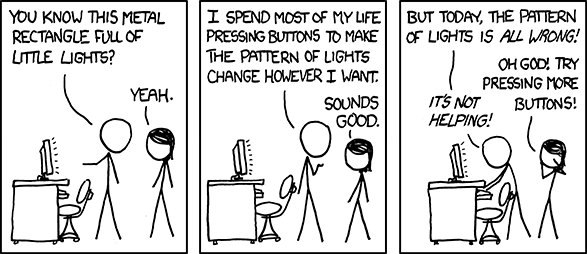
xkcd rocks....
Slogans lifted straight off respective websites. Baaaa....
READ MORE - Superlative fatigue

Musings on education reform

I was just drinking a nice cup of coffee and relaxing during lunch when I had some thoughts about education reform.

1. Are US schools really as bad as people say? Or is the fact that we only evaluate schools based on tests the real problem? Are the tests even valid?
2. To make real, effective and productive changes to education, we need to involve educators, as well as students and parents. Today it seems that most education reform is being pushed by politicians and rich people who have never been in a public school and never taught. Would we allow non-doctors to dictate patient care (oh wait, politicians are in a way with health care "reform" which is as bad as the education "reform" they are pushing for.
3. There are plenty of best practices already available at hundreds, if not thousands, of schools in the US. Why don't we just look to them for ideas?
4. We also have to realize that one size does NOT fit all for education. Differentiation and teacher choice to modify things are extremely important to making students successful in school.
5. Not every student should go to college. Many students are better suited to trade schools and other types of job training. We should make sure every student is prepared to succeed in college, other advanced classes, and work.
6. Let's make it collaborative and not adversarial. Teachers are not the enemy of education. We are the main resource and these education "reformers" have to realize that.


What are your thoughts on "education reform"?
READ MORE - Musings on education reform

Incompetent Teachers or Dysfunctional Systems? Fix the system to support the teachers.


"Incompetent Teachers or Dysfunctional Systems?
Rather than blame teachers, we must ensure that teachers work within a highly functional system that
provides meaningful evaluations, high-quality professional development, reasonable class sizes, reliable
and stable leadership, and time for planning and collaboration."

This is the opening headline for an article by By Ken Futernick that was published in the October 2010 issue of Kappan Magazine

The article makes some very good points about teacher quality vs. the system they work in and how the systems need to be changed more than we need to get rid of teachers. Systems need to help teachers succeed, just like teachers need to help students succeed.

Another great quote: "Poor teaching results more often from poorly functioning systems than from individual shortcomings."

Read it for yourself and see what you think.
READ MORE - Incompetent Teachers or Dysfunctional Systems? Fix the system to support the teachers.