Zeitgeber matters

We keep time in class, as we do pretty much everywhere. We pretend that days are exactly 24 hours long, and that each hour is as well proscribed and linear as he next. An hour in December lasts exactly as long as an hour in June.

Kids know otherwise, of course, at least until we train them.

We start school here in Bloomfield next week. The daylight hours shrink dramatically this time of year. A week from now we'll have almost 20 minutes less daylight than we'll have today. In a month, we'll have an hour and 20 minutes more darkness. The light we do get will be more oblique, less intense.

Science teachers will make a big deal about this, explaining the seasons using globes and lamps, but if we've taught our children that sunlight does not matter, that the clock matters more than your hypothalamus, that we eat at noon, not when you're hungry, well, then, we should stop feigning shock when children really don't pay much attention to sunlight.

None of the adults around them do, either.

If college graduates do not know why seasons happen, or how trees accumulate mass, or what forces act on a basketball in flight, maybe it's not because our children refuse to learn.

Maybe it's because they internalized what we've been teaching them all along....


New leaf--if more than a few children are truly uninterested in a topic, and I have no good reason to push them, drop the topic.

READ MORE - Zeitgeber matters

On nothing in particular

Students seem amazed that the idea of "0" as a number is a relatively new concept, but students also see "0" as a numeral, as solid and inevitable as a "3" or a "7"--as most of us do. How could zero be invisible to the Greeks? (It wasn't, of course...but we only think so because we misunderstand our own concept of "0".)


XKCD rules!


That's not how we use it, though, at least not most of the time in the simple measurements or arithmetic we use in class. Zero serves mostly as a placeholder.

Take the number "306"--the "0" means there are no chunks of tens beyond those already captured by the three hundreds signified by the "3". We have 6 units, true, not quite enough to form a chunk of ten, so we need a way to show this: 3_6.

This is glaringly obvious to many of us who grew up without electronic calculators. The calculator we occasionally used in elementary school was the abacus, which requires grasping the concept of placeholders in order to manipulate the beads, and the slide rule, which requires the use of mental placeholders to make any sense at all.


If you do not grasp the very real difference between zero and the other nine digits, subtle problems arise, which become not so subtle when playing with significant figures ("sig figs"), those numerals that carry any real meaning when we apply math to the natural world.

We too often teach sig figs as a set of rules, which make little sense if the student has a poor grasp of zero, which many--through no fault of their own--do. The rules seem arbitrary and arcane, when, in fact, they define the limits of numerical reality when we measure the natural world.

"Numerical reality" comes off a bit too abstract. I should rephrase this: significant figures define the limits of observable mathematical relationships found in the natural world. The relationships are real, inasfar as they can be measured by independent observers. In class, however, sig figs become an exercise in futility for many.

I think it gets down to the zero. Electronic calculators add a level of abstraction to numeracy, leading to the ridiculous assertion science teachers hear at least once a week: "But my calculator says..."

And indeed, the calculator says exactly what it's supposed to say, when its operators plug in numbers without any feeling for what they represent.

And how could they? The Greeks had the concept without the symbol. We, alas, now have the symbol without the concept.


Yes, I know, the Mayans and Indians and Phoenicians and on and on and on had it down pat.
Thank Fibonacci for getting it to the western folk.


XKCD comic used wtihin his guidelines--very broad ones at that. Thanks! 

And yes, the sig fig rules are a tad arbitrary--range of error makes more sense.

READ MORE - On nothing in particular

Fracking logic

According to the New York State Department of Environmental Conservation, fracturing fluids typically contain about 90 percent water, about 9 percent propping agents like silica sand and less than 0.5 percent chemicals.


*thunk*


When experts spew out statements like this, hiding absolute numbers behind safe-sounding percentages, when they deliberately obfuscate the word "chemicals" to make a political point, and when "journalists" cannot be bothered to research what the "less than 0.5 percent chemicals" contains, my heart trembles for any hope of an enlightened citizenry.

But all that sounds like fearful piffling on my part, and even responding to it makes me sound like a liberal loser wonky type.

Heck, air is mostly nitrogen, with a small chunk of oxygen tossed in. I wonder if the committee that spewed this nonsense would mind sitting in a room with only 0.5% carbon monoxide during one of its meetings.


No, that was not a threat. Allowing fracking near someone's water supply, however, is a threat.
We're letting them frack with our water--what would Thomas Jefferson do?

Cartoon lifted without permission from here.

READ MORE - Fracking logic

Natural world

If you know a bit
About the universe

It's because you've taken it in
Like that,

Looked as hard
As you look into yourself,

Into the rat hole,
Through the vetch and dock
That mantled it.

Because you've laid your cheek
Against the rush clump

And known soft stone to break
On the quarry floor.
Seamus Heaney, from "A Herbal," Human Chain


***

I got whomped pretty good by a virus last week, you may have, too--it's wandering around.

Viral illness fascinates me for a variety of reasons. Pieces of viral nucleic acids take over your cells for no particular reason except to make more copies of the same nucleic acids. We respond by using eons of evolutionary memory built into our own DNA, waking up specific antibodies to tackle a problem seen before by our long gone ancestors.

This particular bout with a virus had the added bonus of hallucinations--not the feathery, febrile kind, where various blobs of color bounce through your field of vision as your teeth chatter. No, these were different--they were real.

Solid, opaque objects meticulously placed in a couple of spots around the room grabbed my attention as I lay in bed. I woke up Leslie to confirm that they were not, in fact, real, though they were as real as the cup of coffee sitting next to me now. Rock solid real. (We've been together a long time--she answered directly, then went back to sleep, just as directly.)

The only reason I even questioned their reality was because there was no particular reason why a couple of large cubes would be stacked on the corner of the bed.

In the morning,I asked Leslie if I had, indeed,asked her about the boxes sitting in the room. I had.

Most sensible people would have seen a doctor, but since we conveniently have one under our roof, and since I was otherwise OK except for the usual virally fever, sore throat, and muscle aches, I opted for watchful waiting, and except for a diminishing malaise, I have, as expected, recovered.
***

Most high school science classes start out the same way--before plunging into a specific -ology, we toy with the concept of science. We speak of learning more about the natural world.

It occurs to me, a few years late, that few people (besides scientists) know what "natural world" means, and the scientists know that what we know is tenuous, at best.

That's not how my lambs hear it--the "natural world" is as obvious as the noses planted on their faces. Really, just how daft is this teacher?

What makes something real in the natural world? What is the essence of stuff?
***

Biology is the study of how stuff puts itself together over and over again, and how energy is glommed to make this possible. A century ago, biology mostly taxonomy, a great way to teach children how to look for nuances as they classified and dissected hundreds of organisms into various categories.

This year I will spend exactly one day on taxonomy--which is one day too many the way we approach it now.

My students have not yet had chemistry, or physics, or geology--yet we expect them to learn molecular biology. This is, of course, silly, so I spend most of the year exposing children to fancy-sounding biology words but sneaking in basic science epistemology every chance I get.

What do we know, and how do we know we know it?
***


Until kids grasp the circularity of our most basic assumptions about matter and energy--sophomores are not quite ready for quantum mechanics--most see science as solid as the odd solid blocks someone placed on the edge of our bed last week.

They are studying hallucinations, and see them as real, because they have been told, over and over again, that they are real.

They believe in atoms atoms (or rather what teachers present as atoms) are real, without grasping their vast emptiness.
The atoms taught in elementary school  do not exist. If a nucleus is the size of a dime, the electrons would fling as far as half a football field, and even that's just an average. What's in-between? Nothing. Nothingness is a huge part of everything.

They believe in the Big Bang, imagining an explosion in empty space, truly magical thinking and a misconception of an conceptually inconceivable model, and we feed their misconceptions.
The Big Bang, as understood by most, ranks right up there with Santa Claus. The whole point is that there was no space--all energy/mass was a point, so distance, as such, did not exist. A picture of the Big Bang as seen from the outside is not science, it's religion.

I get too strident, not because I know something students don't, but because we keep assuring them that the nonsense they know is "science."
***

Schools muddle things up pretending that a young child who parrots science vocabulary knows more than the child babbling on about the Easter bunny or a schizophrenic babbling about critters implanted in his brain.

We praise hallucinatory thought, and we suffer the consequences.

My goal is for kids to know less by June than they knew in September, a whole lot less. Good science can be as tenuous as the wisp of a shrew's breath.

Until they know this, and it's easier to grasp when entropy takes its toll over the years, as knowledge of your inevitable path creeps into cerebral shadows, I fear I am wasting their time.

Until they know this, maybe pushing them outside, a copy of Seamus Heany's Human Chain in one hand, a cheap plastic magnifying glass in the other, is enough science for a period, for a lifetime.

Between heather and marigold,
Between sphagnum and buttercup,
Between dandelion and broom,
Between forget-me-not and honeysuckle,

As between clear blue and cloud,

Between haystack and sunset sky,
Between oak tree and slated roof,

I had my existence. I was there.

Me in place and the place in me.
Seamus Heaney, from "A Herbal," Human Chain


Which is all we can ask for, all we can know.
The rest is hallucinatory.


The pieces of poem are from Seamus Heaney, obviously, but are meant to be read as part of a larger piece, not included here because I'm already pushing copyright law. Buy the book. Read it. Then a few weeks later, read it again. Months later, again. He gets it, this whole 'thing' thing. Eases some of the fear, no?
READ MORE - Natural world

Hiroshima


広島


Sixteen hours ago an American airplane dropped one bomb on Hiroshima, an important Japanese army base. ... It is an atomic bomb. It is a harnessing of the basic power of the universe. . . . What has been done is the greatest achievement of organized science in history.


It happened on this date, this "greatest achievement."


New technology used to "solve" an old problem. We cannot help ourselves.

Wes Jackson, founder of the Land Institute, suggested "we ought to stay out of the nuclei." Until we have a clue what we want, sounds like good advice.

You cannot separate tools from the critters who use them. Teaching science as some compartmentalized thought process without cultural context is a dangerous game.

What is our responsibility as teachers of science?
As citizens of the United States?
As human beings?

***


This morning I saw a wasp dragging paralyzed cricket along the edge of the driveway. The wasp was not much bigger than the cricket, and the wasp struggled. At one point she let go, stepped back a few inches, stroked her head a few times (much like a human facing a big task), and eventually dragged it down a hole by the driveway garden. The cricket was still alive, but paralyzed.

I did not intervene.

The wasp will lay her eggs in the cricket, and they will hatch in the cricket, still alive, and the cricket will, of course, suffer.

I did not intervene.

The larva wasp will use the the cricket, still alive, for food.

And still, I did not intervene.


Photo by Bruce Holderbaum

***

We knew the world would not be the same. A few people laughed, a few people cried, most people were silent. I remembered the line from the Hindu scripture, the Bhagavad-Gita. Vishnu is trying to persuade the Prince that he should do his duty and to impress him takes on his multi-armed form and says, "Now, I am become Death, the destroyer of worlds." I suppose we all thought that one way or another.
-J. Robert Oppenheimer


Ken Allan is a blogger on the other side of the Earth. ( Kia ora e Ken.) He's quirky, bright, thoughtful, and well worth reading.

He sent me the this video:


And now I teach science to (very) young adults. I have a responsibility to them, to the state, to myself.

Harry S. Truman called the bombing of Hiroshima "the greatest achievement of organized science." If that does not give you pause, you should not be teaching science.

You should not be teaching anything at all.


(Yes, this is from older posts, timeless ones.)
The photo is by Bruce Holderbaum
and can be found here--used with permission.


This is posted every year, as a reminder to me.
READ MORE - Hiroshima

Stars and storytelling

I've been immersed in the new esocial culture the past week, even carried around an iPod for a couple of days. I wandered down to D.C. for the march, then back up to NYC for #edu140.

I saw incredible visionaries seduce their audiences with words, with music, with movement, with touch. I mainlined social media for several days, dizzy with various boxes of multiple colors, floating on a collective stream of human consciousness, and last night I crashed.

It took two words from my son as we got out of the car at 2 AM this morning: Look up!

The milky way streamed over our head, parting around the Northern Cross. Ancient patterns of stars raced through my brain--not just the neocortex, the part we worship, but arcing through the limbus, the edge, the old mammalian brain, the home of desire. The hippocampus, our ancient compass, screamed for recognition, finally allowed to guide me under something I deeply recognized, something beyond human.

The amygdala, our kernel of fear embedded with wonder, ripped my attention away from my neocortex--words dissolved, language did not. The stars spoke to me, as they do to any mammal wending through night's shadows.

We forget, or maybe the human part of us, the folds upon folds of new cortex that allow us to navigate in our human world, forces us to look away. But the neo-cortex is only part of the story, and not the one that will save us.
***

Astronomy, until very recently, was a story told only of light, but what a story we created. We learned of suns and stars, galaxies upon galaxies, of an expanding universe by creating layers of inferences, stories upon stories, based only on light.

Helium, named for the sun, was discovered on the sun before we found it on Earth, betrayed by its spectral lines.

How many of our children know this? How many adults?

Science is not "knowing" that the sun holds helium--to say this is not to say much, though trivia often passes for science in our culture. Science is grasping the stories of light, of spectral lines, of inferences, and then sharing the stories with others.

If children knew how tenuous our grasp of the universe is, as we try to hold hands with the shadows dancing on the walls of Plato's cave, they'd be a lot less frightened of science teachers, and maybe more frightened by our stars at night.

Fear is underrated.
***

While the stories of science are based on tenuous grounds, the stories are solid. They work, much as the stories we shared before we had written language, as we gathered under the stars on moonless nights, worked for us then.

The children of my ancestors 50,000 years ago had the evidence above them, they felt the creeping dread of the amygdala tempered by the guidance of the hippocampus. Their stories were based on evidence, the evidence of the stars, not the words of a textbook, the words of an expert.

We have become a nation of magical thinkers. I wish I could say this was despite our science education, but too often it is because of it.

For decades now, we have dropped observation of what's real for immersion of what's not--words and photographs and monitors and videos are not real. No media today can hope to capture the sky that wrapped its way around my nonverbal brain just a few hours ago.

If a child uses a computer before she uses a magnifying glass, her science has been stunted.
***

I proctor the BHS Sidewalk Astronomers, a school club that lets kids see a tiny piece of the universe, catching photons in light buckets we set up on the pavement outside our school.

I used to apologize for the poor viewing conditions, but most have never seen truly dark skies, and are thankful for every photon they catch with our telescopes.

The telescopes are easy enough to grasp--you can see the big mirror bouncing light to the smaller one, you can see the eyepiece glass focus light as you slide the tube up and down with a simple knob gear.

No magic involved.

 ***

Cell phones are magic, iPods are magic, wifi is magic, even televisions are magic to most who use them.

I can at least show children how speakers work, using nothing more than a paper cup, a coil of wire, and a magnet, but do not show them how the amplifier that drives the speaker works. (The last time our class made a speaker, it literally went up in smoke, a great lesson in vibrations, sound, and heat.)

I'm done with magic. I'm done pretending we can survive as a culture pushing magic.
  • Magical thinking is what leads rational adults to believe that plugging an electric car into a socket makes the energy "cleaner." 
  • Magical thinking is what leads a culture to putting more calories into the ground than can be extracted from its harvest.
  • Magical thinking is what leads us to believe that we are beyond the laws of physics, that human western wisdom is beyond our collective wisdom, that our minds can solve any problem our brains manage to create.
I'm going to teach my students the first week of school the difference between the magical and the true. I am going to encourage them to catch me every time I slip into magical thinking. We're going to spend a lot of time delving into why their science teacher, despite himself, keeps slipping into the world of magic.

We will learn what's true together, and if a child should escape our haze of urban light and stumble under a sky burning with stars, she will have enough trust in what's true to trust the stories they tell, and have told, since before we uttered our first word.

I'm done with magic. Magic is limiting. Magic kills thinking, kills hope, kills people.


Perseids woodcut via NASA but from 18th c., so I figure it's OK to use.
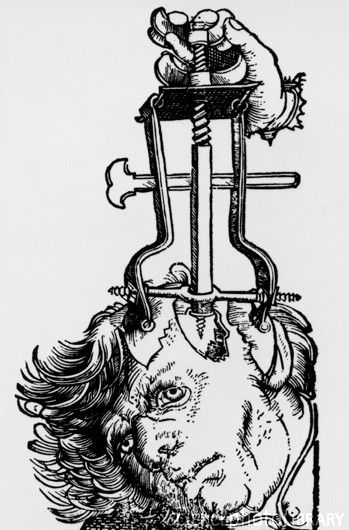
Book of Wound Surgery of Jerome of Brunswick (also called Brunschwig) published 1497, via Science Photo Library, but also ancient enough to skip the legal nonsense.
READ MORE - Stars and storytelling

Unanticipated, but not unnatural

CO2 is denser than air. This is easily demonstrated in class.

Combine vinegar and baking soda together in a beaker to generate the gas. The students will groan. Yeah, we know this already, it bubbles.... Ask them what bubbles, and they will tell you what everybody already "knows"--carbon dioxide.

Now light a candle. As a diversion, ask them what gasses are emitted (CO2, H20), then hold the beaker over the lit candle, and "pour" out the CO2, leaving the foamy liquid.

A second or two later, the flame dies, as if sucked back into the wick.

What happened?
***

Just a few hours ago, hundreds of dragonflies swooped around us in the dying dusk. A cold front had just passed through, and the critters were feasting on the swarming insects trapped at the bay's edge, where horseshoe crabs have just about finished their annual orgy.

Dragonflies and horseshoe crabs both came through the Great Dying, a quarter billion years ago. Most of life was destroyed in an event far more extreme than the last mass extinction that ended the age of dinosaurs.

Though it's not clear what happened, extreme CO2 levels likely played a role. CO2 snuffs fires, CO2 snuffs life.

This August marks the 25th anniversary of the Lake Nyos disaster--over 1700 humans killed in Cameroon by a cloud of carbon dioxide exploding out of the lake in a 100 yard high watery mountain of foam, as tall as Manhattan's Trinity Church, the gas suddenly released like the effervescence of  millions upon millions of bottles of seltzer.

The heavy gas flowed down the walls of the volcanic lake that released it, a deadly spree, depriving the living of oxygen as it pushed up the lighter air.


Unanticipated, but not unnatural.

Some locals briefly attributed the devastation to Mami Wata, to a neutron bomb, to "strange Europeans...heavy-set, menacing Nordic...motorcyclists" seen just before the explosion. The eruption had been predicted by a healer who himself did not survive.
***

251 million years ago, carbon dioxide obliterated over 90% of the species around at that time. So little plant life grew that there's a "coal gap" in the fossil record--a 10 million year span where no coal was formed. And yet, the dragonfly line persisted, the horseshoe crabs, too.

These ancient creatures once frightened me with their compound eyes, their complex symmetries, their deliberate living, their bodies so perfectly fit for their niches that little has changed in hundreds of millions of years.


In biology, perfect life does not exist. In biology, the environment defines those who are less imperfect.

But if perfection does exist in life, if there are life forms that will continue to see the dying dusk so long as the sun casts its energy on Earth, it might be found in the creatures that share edge of the Delaware Bay, the bizarre ancient forms of the dragonfly, the slow creep of the horseshoe crab.

I do not know how many of us know the story of Lake Nyos, the stories of Mami Wata, the stories of the horseshoe crabs and the dragonflies, the story of the Great Dying so long ago.

Something so simple as the gas brewed from baking soda and vinegar can silently kill something as complex as a mammal. Next time I snuff a flame with CO2, I will share the story of Lake Nyos, of the Great Dying--these are the stories that define us, stories that may someday save us.


Our stories make us worth saving.

Candle image by Matthew Bowden, who freely share. Thanks!
Lake Nyos photo by Jack Lockwood, USGS, in public domain (via Wikipedia) 
READ MORE - Unanticipated, but not unnatural

"A Framework for K-12 Science Education" released today


A Framework for K-12 Science Education: Practices, Crosscutting Concepts, and Core Ideas was just released.

One of my few frustrations with teaching science at the high school level are the misconceptions kids carry up from lower grades, or from life in general.

I spend a lot of time on misconceptionectomies, but they are resistant to quick cure, particularly if reinforced in the younger grades.

It's OK to teach incomplete science in 2nd grade--it's incomplete even at the highest levels of formal education. Science will always be incomplete, a big part of its appeal. It's plain wrong, though, to teach bad science.

So I am heartened to see this:
"Clearly, incorrect beliefs—such as the perception that food or fuel is a form of energy—would lead to elementary grade students’ misunderstanding of the nature of energy. Hence, although the necessity for food or fuel can be discussed, the language of energy needs to be used with care so as not to further establish such misconceptions."
Italics added


If you teach science, go get this--it's free, and it will affect your classroom in the years to come.
READ MORE - "A Framework for K-12 Science Education" released today

Why are blueberries blue?

The dead brittle branches of February now hold hundreds of berries--most still a ghostly green blue. A few have ripened to the dark, deep blue depths of light that remind me of the very young, and the very old, of the transitional cyanosis of a newborn struggling with its new world.

Light is a funny thing--we see what's reflected, not what's absorbed, of course, but the reflected light becomes the object, at least in our minds. That's how we survived through millennia.


That berries change color is obvious. The how, less so, but we got fancy words and molecular structures to dazzle any child who dares ask. Answering the why is the tough one.
***

If a child asks "why are blueberries blue?"--not an unusual kind of question in a science class--how do you answer it?

This is not a trivial point. We live in a culture that defines knowledge as bits of information, and how I approach a child's questions helps shape how she sees the world.

Some possible answers follow, along with my issues with each.


Blueberries are blue because they have anthocyanins....
Unless you are teaching a post-doctoral botany student in grad school, this is like saying blueberries are blue, because they're, well, blue; saying anthocyanin adds nothing to the child's grasp of the universe. If she is satisfied by this answer (and she may well be given the way we teach "science"), she learns that what matters in the classroom are the words that signify the universe, not the universe itself.

The answer isn't wrong, it's just inane. It goes from inane to insane when we promote this as science. It may be cute to hear little ones parrot big sciency words, in the same perverse way it's cute to promote beauty via pageants for 5 year old children, but it's a dangerous pedagogical practice.

Blueberries are blue so we know they're ripe...
No doubt blue blueberries taste a lot better than the less mature green ones, and yes, there's a complicated relationship between seeds ready to germinate and the sweet juices surrounding them tempting animals to eat them. Raccoon scat around here can be loaded with seeds, and some gardeners will swear that blueberry seeds grow best after traveling through a mammal's gut.

If you have the time in class (days or weeks) to digress digest this, to pursue the bioenergetics of sugars and scat, to explore evolution, then this answer can go a long way. If you shorten it to "so we know they're ripe," you've just placed the child in the center of the natural universe, and set back her chances of grasping descent with modification later.

(Language matters--yes, we know they're ripe because the berries are blue, but that is not why the berries are blue, at least from the point of view of science. )

Blueberries are blue because God made them so...
The problems with this answer should be obvious, but these days some folks need it spelled out. Science does not dabble with the supernatural. It has no truck with miracles, either, for a variety of reasons.

Despite the noise from some corners, not all science teachers are godless atheists trying to subvert your child's mind. Atheism requires more faith than I have.

So how do we answer seemingly simple questions in class? Very carefully. Sometimes no answer is better than any answer. If I'm stuck, I'll often probe a bit to grasp what the child is really asking--and many time the child does not know either.

Uncertainty is fine with me--far more damage has been done by folks who know the truth than those of us plodding along the nooks and crannies of the natural world.

I have faith that my blueberries will ripen, and enough biochemistry background to grasp how they will ripen. I'll save pondering the why until the day's end, as I sit on the patio watching the nearly full moon inch up over the maple tree in back, sipping melomel made from last year's blueberry bounty.


The blueberries in the photo now sit in my gut. Yum!
READ MORE - Why are blueberries blue?

A clammer meets the internets

After yesterday's dust off, where I tangentially blame modern technology for the impending collapse of, well, everything, I thought I might need to re-establish some semblance of credentials for the edutech crowd, and perhaps even more important, potential employers.

I had long planned to go clamming this morning. We got people coming over tonight, and nothing beats fresh clams, except maybe fresh tomatoes, and we got those, too.

My trusty paper tide charts (courtesy of Jim's Bait and Tackle), confirmed online,  predicted that the sweetest clam bed south of Newfoundland will lay open mid-morning today.The kayaks are loaded, my clam bucket sits on the back stoop, and my rake is repaired and ready.


Alas, it rained last night. Rain flushes out the street sewers, which hold pretty much anything and everything the ground holds--cigarette butts, squirrel poop, herbicides, human spittle and other fluids, and all kinds of other matter subject to the law of gravity. A cherry stone will filter about 10 or so gallons of baywater a day, and I figure a chowder might do double that.

I have a general policy similar to a few states (though New Jersey, land of the free-to-ingest-whatever, is not one of them)--if it rains a decent amount the day before clamming, best not clam.

A decent amount for me means 1 inch, from the Latin uncia, 1/12th. Why a twelfth? Why a foot? What science is behind my tolerance? Well, very little. I surveyed the internets again, saw that Maryland closes beds for 1" rainfall, Massachussetts uses 1" in the winter, but only 0.6" in the summer (more squirrel poop around, I guess), and NJ, well, last time any bed got closed for rain was a year ago April so maybe we're not paying real close attention.

We got dumped on last night. How much? Well, I could wander outside and peek into a bucket, all of 15 feet away, but then I'd need to find my measuring tape, last used to measure the fluke I cannot keep, which means finding my fishing bag, which I think I left in the car, and, well, it's easier to look at a screen than get up and walk. Besides, it might be muddy outside. Not to mention the squirrel poo....

According to the internets, our local airport, only a couple of miles away, got 1.89 inches of rain last night. (Imagine that, we're measuring to the hundredths of twelths of some ancient foot standard...a freaking fifth of a millimeter for our more enlightened global neighbors....and which just happens to be the length of your run of the mill Paramecium caudatus.)

So no fresh clams tonight....had it rained 90 paramecium lengths (PLs) less, that is, had my bucket outside only held 99 PLs instead of the 189 PLs it would have held had I left it right side up and moved it two miles away to our nearest airport, I'd be clamming at this very moment, risking skin cancer and contamination with squirrel poop.


Here's a picture of a P. caudatus, just in case we go to that as a standard:


The paramecium photo is by Barfooz, released under Gnu FDL
READ MORE - A clammer meets the internets

Thermometers, yet again

If you stick your hand into a half full jar of sourdough pretzels in a Jersey July, you will feel your hand get noticeably cooler. Really. Try it.

If you measure the temperature inside the jar, it will be exactly the same as the temperature outside the jar. Any child with any sense and a respectable contempt for authority will tell you this. It's cooler in the jar!

It definitely feels cooler, yet the thermometer says otherwise. What's going on?

(Hint: this wouldn't work in Phoenix.)

Turns out experience is local. No national science curriculum can tolerate the very different results of my pretzel jar demo, a shame, really, because the children in Phoenix can very easily (and cheaply) discuss their results with the children in the humid halls of Bloomfield. Skype, blogs, wikis, heck, even phones.....

The humidity in the jar is much lower than the humidity in most of Jersey. Sodium chloride ("salt") is really good at grabbing water molecules from the air. The salt on the pretzels in the jar assures a low humidity environment, at least as long as you keep on the lid.

2nd graders do not need to know terms like "sodium chloride" or "hygroscopic." They should know, however, that science and intuition are not mates. They should know that science is based on what we call the "natural world" (itself a concept 2nd graders have a shot at grasping). They should know that science is testable.

I really don't give a rat's buttocks if a child can convert Celsius into Fahrenheit--that kind of skill matters, true, but that's not science, and it's something I can easily teach. I do care if a child is curious enough to wonder why her hand feels cool in a bucket of Snyder's Sourdough Specials.


Good Lord, I need curious children.We all do.
READ MORE - Thermometers, yet again

Independence Day


I love the Fourth of July. Today we feasted on the first local tomatoes, a completely different beast than the imposters sitting on your grocery shelves. I ate a peach that grew less than two miles from here, its impossibly sweet juice leaving a puddle at my feet. The basil grows like weeds in July. In July, the grasshopper makes more sense than the ant.

America is a great place to be if you have a patch of land and love to eat. Jefferson said each of us should have a patch of land if democracy was to flourish. That we mostly don't and that democracy mostly doesn't is no accident.

This American experiment has withstood greedy yahoos in the past, and if we keep our wits about us, will withstand the current nonsense the people in suits.

America never was about the people in suits. The powerful know this, but hoi polloi occasionally forget, which is how we get into messes like the current nonsense with NCLB, a child of doublespeak and magical thinking.

***

Science tolerates neither.

When a child learns how to rationally, how to discern what's real from what's not, and even more important, learns to treasure truth, demagoguery dies.

Teaching matters for a lot of reasons. Preserving the thin thread of democracy in its agonal breaths here in a land bought and paid for by Arne and Eli and Bill matters.

History matters. Science matters. Art matters. Language matters. Vocational arts matter. (Really, Arne, when was the last time you fixed anything?)

For all the labels that divide us, promoted by a class that feeds our divisions to enhance their power, we're most of us are still united by our belief in the land and our Constitution.

Crispus Attucks
gave up his life in 1770--read his history. This country was not founded by the suits. The land belongs to us.


Yes, I know that's George, not Tom.... 
Pictures by Leslie. North Cape May rocks. Go us.
READ MORE - Independence Day

Thermometers, again

Thermometers work by magic, or may as well, given the  way we use them in class.


Lorin King, released under CC 3.0

We focus on how to read them, then how to convert one reading to the other. If a child barely has a grasp on Fahrenheit, it's really too much to ask her to convert to Celsius, not matter how much more sense it might make. Kelvin is just Celsius with a degree in pedantics.

A child can observe the triple point of water, at least two parts of it. (Water vapor is invisible--the fog you see is condensed water--droplets of liquid.) A child can tell when water is boiling.

Give a child a thermometer without numbers, without lines. Let her figure out why calibration matters. Otherwise a thermometer is just another talisman in a republic that cannot survive magical thinking.


The worksheet made by Lorin King, released under CC 3.0
READ MORE - Thermometers, again

Stories matter

"Remember when..."

Late June is a great time to be an American. Stories are told during the long, soft dusk. Lightning bugs almost make up for the skeeters. Talk swings from baseball to beans, passing through epic feats of failure, now funny stories weaved between births and deaths.

"Jodie's not so well... Gawd, how Anna has grown! 6 months?... Really? She barely shows....We're hanging on, barely....What a wedding!....Goodness, it's lovely out tonight....."

We laugh, we drink, we eat, we share.

Your children are not truly competing with the Chinese children or the Finnish children or the Indian children. Our children are now seen as chattel, penned in the same cell as any other child. They are all competing against an international corporate structure that protects their own children at the expense of all others. No, it's not some sekrit international plot--it's just human nature gone amok....

It doesn't have to be this way. We got good earth, and water, and trees, for now. We have seas with fish, and plains with grain, for now. We have coal and wind and sunlight. We have a reasonably moderate climate, for now.

We also have a story, a good story, and a constitution, a good constitution. We have wonderful parables--Johnny Appleseed, Annie Oakley, John Henry. We're the goofy, kind folks who left our native lands, folks who  can solve pretty much any problem tossed our way, in unexpected ways.

When did arrogance and efficiency and misplaced elitism become our story? Why do we care what Bill Gates and Eli Broad have to say? How does a man like Arne Duncan become the national figurehead for what used to be education?

When did we stop wanting to be Americans?
***

I'm not raising children to be chattel. A well-educated child, one who knows where she came from, knows her land, and knows what's possible, makes for a lousy slave.

There's a good reason literacy creates turmoil in tiered cultures.

Literacy takes time.
Education takes time and room.
Living well takes time and room and wisdom.

Our national leaders spent their lives rushing to "there" without ever knowing "here"--hard to love a land you know only abstractly. Hard to love anything you know only abstractly. It's impossible to rightly care for something you don't know how to love.

Love of our land can start with the simple act of putting a bean seed in a recycled milk carton, filled with dirt scooped up by a child's hand from the ground next to the school building. It can start with a walk to the closest stream. It can start with listening to a grandmother describe what her town looked like a few decades ago, when people knew what a stoop was for.

Not sure growing a bean will help a child on the NJASK, our tithe to the NCLB nonsense. But I am sure of this:

A child who has a love of place, of life, of the universe has a better shot at happiness than one who does not. Few things are more dangerous than an educated adult with no sense of place. Right now they're running the show, and telling the tales.
***

You don't need a tinfoil hat anymore to be a conspiracy crank. Here's a headline from today's Star-Ledger:

N.J. hedge fund leaders create group to financially back education reforms supported by Gov. Christie

Last week we got this:

Christie's proposal would give private companies unprecedented control of failing N.J. public schools


Chris Cerf, our Acting Commissioner of Education, used to be the CEO of Edison Schools--ask him how things went in Philly and Baltimore. He knows the problems. He's bright, he's personable, and I trust his heart is in the right place. I tend to trust a lot.

Yet here we go again. How does a bright man with an intimate role in the history of failed privatization of public schools keep doing what he does?

I have a hypothesis (hey, I'm a science teacher)--I suspect that he and those he hangs with share different stories, stories framed by private schools, hedge funds, and power. While Mr. Cerf was cutting his teeth as a teacher at Cincinnati Country Day School, I was busy chelating lead poisoned kids in Newark.

Fancy day schools will pluck out an occasional child of color from the inner city--makes making the websites and pamphlets more, um, democratic. They won't be taking the child whose brain has been severely damaged by lead. They won't be taking the child whose life crises leave a legacy of outrageous behaviors. 

They don't need to--it's not part of their story. They don't know those children even exist.

But I do.


To his credit, Mr. Cerf did spend some time with me, far more than I could have hoped for.
I don't want Zuckerberg's money, I don't want to administrate, I don't care much for meetings.
I do care about the kids, and I do care about my profession.
I know a bit about both. 
READ MORE - Stories matter

June ramblings

I'm reading Umberto Eco, a June indulgence. He's bright, and interesting, and mostly right, but he's also, well, um, a professional dilettante. I have nothing against dilettantes. in another lifetime I'd consider being one, but in a time when honest folks can't find a job, dilettantes seem obscene.

But if you have the time, he's worth a read.
***

In Language and Lunacies, he argues, among other things, that we believe, "as factual truth, that the chemical composition of water is H2O." We teach it as such, but it's not true.

Imagine a solitary molecule of water--what properties could it possibly possess? It would have to be gaseous, since it has no connection with its neighbors, and even then, alone, it really has no special qualities.

Water behaves as water because water has an unusual attraction to itself--the Brittney Spears of molecules. We call this hydrogen bonding, but no matter. Without other water molecules around, the concept of H2O is a human conceit. (To be fair, it's a human conceit anyway, but not in the sense that Mr. Umberto recognizes.)
***

I will bore the love of my life with this tonight--I will prattle on, so I will save you the grief. But I will say this much.

If you think you know anything about water because you call it H2O, you are mistaken. Calling it "H2O" only means that you know it takes two parts of hydrogen for every part of oxygen, and few of us take the time to accurately measure how much water gets generated every time we blow up some hydrogen.

We practice a lot of pseudo-science in education. We encourage an Asperger's Syndrome culture, spouting off "facts," without any connection to the ground that's under my bare feet as I write.

We really know nothing, and that's OK, so long as we remember that the stories we tell are resurrections of the stories told by pretty much any vertebrate with a brain. "I'm here! I'm here! Listen to me! Listen to me! I have a story to tell!"
***

Which brings me to the Big Bang. This is a wonderful story--we have characters and drama and intrigue--but ultimately it is absolutely (and I do not use the term loosely) incomprehensible. If you tell a child that the universe erupted from a single point, and that child dutifully records such nonsense in her notebook, and you let her without letting her in on the secret, then you may as well teach astrology.

And a lot of us are teaching astrology.

Astrology's interesting, but not nearly as interesting as a teaspoon of soil, a drop of water from the Delaware Bay, the purple shit of a common robin.


If science does noting else, it should remind a child that the universe exceeds our imaginations, and that the stories derived from the natural world , our stories, exceed the stories about humans alone.

Most cultures know this. Our culture mastered metallurgy, and weaponry, and we forgot. God help any culture that is bold enough to remember. We destroyed the Amerinds, the Incas, the Aztecs, the Afri. Don't screw with us. We shoot, then let God sort out the souls.
***

As I write this, a robin dances a couple of yards away from me as I water the garden. He's a couple of years old--he knows me, and I know him. I could make up a tale, anthropomorphize him, but that would require a huge assumption, that I know more about him than I do.

If you're going to teach in any way that matters, you're going to have to challenge assumptions.

So this is what I know.  When I water my garden, he eats worms that erupt from the earth. He's alive, I'm alive, and we share the same mitochondria, the same ribosomes, the same ancestors. We're cousins.

If you internalize this, you're less likely to wipe him out. If you're less likely to wipe him out than the Eurodescendant next to you, you're less likely to have a seat at a boardroom table.
***

So I teach.

The commissioner of education in this fine state calls me an "ankle biter." I doubt that Arne knows who I am, but I also doubt that his view of me would be any more flattering than our commissioner's. '

At least one robin loves me, a few mature humans, and maybe even a child or two.

That a child even needs a gateway to the world, the natural, real world outside the pixels that damn her to a life of drudgery and limited choices, is sad. But she does. And I consider it an honor to be that gateway.

Arne doesn't know this world, nor does Bill or Eli or the Acting Commissioner of Education here in the Garden State.

But I do.

And so will every child that walks into my classroom.


I love June. I'm brave in June
Lord, please, let mebe brave when the sun runs away again....
READ MORE - June ramblings

First lightning bug

I run this every June, because I like lightning bugs.


First lightning bug tonight. I never tire of lightning bugs.

I

Dusk settled on the lake. I could hear the kiss of bluegills as they sucked down insects struggling on the surface.

A few lightning bugs flashed above the mirrored surface. Attracted by their own reflections, they swooped ever closer to the lightning bugs flashing below them.

Fish may not be smart, but they're not all get-out stupid, either. And a bluegill will jump if hungry enough. A few were hungry enough. Inside their bellies glowed a few foolish lightning bugs.


II
Lightning bug light is cool-literally. Luciferin combines with ATP, the energy molecule of life--the resulting compound combines with oxygen, catalyzed by luciferase, and light results. Even tiny amounts of ATP will cause luciferin to light, as long as oxygen is present. While man has never been to Mars, bits of lightning bugs have--luciferin is an extremely sensitive detector of ATP. If it flashes, carbon-based life may be present.


Luciferase from the North American firefly (Photinus pyralis) is the enzyme of choice for reporter gene assays. Luciferase catalyzes the oxidation of a firefly-specific substrate called luciferin to produce light. This reaction is extremely efficient and the quantum yield is the highest of any characterized bioluminescent reaction. The bright signal makes this a valuable enzyme to use for reporting promotor activity. • Packard’s LucLite® assay system, introduced in 1994, produces a long lived glow type signal with a [half-life] of several hours, which makes it ideal for use in noninjector based HTS luminometers, like the Packard TopCount® NXT Microplate Scintillation and Luminescence Counter or the Packard LumiCount® Microplate Luminometer.
Luclite Plus Reporter Gene Assay System, 20,000mL from PerkinElmer, http://www.biocompare.com/itemdetails.asp?itemid=389636&catid=1620

Scientist have yet to synthesize luciferin, so they buy lightning bugs.


III
My daughter dug out a tiny mudhole for me in our backyard. At dusk, I sit opposite the pokeweed I am learning to like, under a stray white birch I have always liked. Lightning bugs arise from the earth, flashing their "J"'s, looking for love. Harry Potter, like the Bible, makes sense sitting outside on an early June evening.

I read until the dusk chases words off the page, my feet resting on a small stone wall we built together.

A flash just below my right foot.

I break from Harry Potter. A second scurrying critter rumbles about the flash. The flashing becomes frantic, several short blips in less than a few seconds. My eyes adjust--a spider dances around its prey.

I've never seen a lightning bug flash quickly like that, but then I've never seen one eaten by a spider either. A lightning bug makes a flash by adding a tiny bit of ATP to luceferin. In our mechanistic view of the world, not a bad worldview if you're in the business of conquering it, lightning bugs flash instinctively. They are not known to flash for defensive purposes.

I cannot know why this one flashed, but I do know that lightning bugs, at least this one, had a pattern distinct from its cherchez la femme mode when struggling with a spider.

I almost didn't try to "save" it--a good naturalist observes, does not interfere. The spider has as much a right to the meal as I do to mine. Death by spider is likely to be quicker than death by starvation if the critter could no longer fly.

I pulled the frenetically flashing bug out of the web--a white wisp of web stuck to its backside. I set it on a leaf of the birch with mixed feelings. It will die slowly because my imagination would not allow me to let the spider bite it.

As the critter struggled with its first pair of legs to grasp the edge of the leaf, I gently pulled back the stick. The spider silk stuck to my stick. The lightning bug scootched a few millimeters, no longer flashing, and stood still.

I watched a moment longer. The lightning bug opened up its beetley shell, opened its wings, and flew away.

A moment later, a lightning bug brushed my leg at the bottom of its "J". No way to know if it was the same one. And it really doesn't matter.


IV
Some Asian lightning bugs flash in unison. The lightning bugs in the Jersey area, at least the ones that make a J, are not known to do this (according to the scientists). Oh, occasionally they'll accidentally flash together a few seconds after the flash of a bright light, as though they were all resetting their bellies after seeing a god, but left alone, our fireflies are supposed to be the individualistic sorts.

The local critters must be illiterate--once or twice a dusk, they amuse themselves with synchronous flashing. (“Amuse” sounds like anthropomorphizing, of course--it’s an interesting word, comes from the French amuser, “to stupefy”--we’re most amused when our brains are buggy.) .


V
One poor fellow one evening couldn’t turn off his belly --he’d glow properly enough in his “J”, but still fizzled a bit as he looked for a response--doubt he could see much light beyond his perpetually lit self.

I muttered “padiddle.” .


VI
Lightning bugs are, obviously alive. They have a lot of ATP. They have a lot of luciferin and luciferase. We made lightning bug earrings, lightning bug drawings, we’d smear dying and dead lightning bugs over our faces and laugh and scream like the atavistic creatures we were, mock Indian face paint.


VII
I am a science teacher; I am not a scientist. A lot of folks are confused about what constitutes science. We want children to be amazed. You can purchase, via PayPal, a lightning bug “collection system.” You have a choice of sizes, and the handle glows in the dark. Imagine that! No doubt safer than punching holes in a half-rinsed mayonnaise jar.


Kids can study and be fascinated by all the little bugs found in the average back yard. Firefly lanterns allow children to watch the lighnting sicbugs light up. The bugs can be returned to nature where they were found after a day or two of enjoyment.
Plum Creek Marketing Entomology Products for Kids.


Another “experiment” suggests that kids catch lightning bugs in a jar for 5 minutes, record their observations, then let them go.

Took me 40 years to realize I learn a whole lot more doing nothing, feet up on a tiny stone wall next to my daughter’s puddle.


Photo by me.
READ MORE - First lightning bug