Natural world

If you know a bit
About the universe

It's because you've taken it in
Like that,

Looked as hard
As you look into yourself,

Into the rat hole,
Through the vetch and dock
That mantled it.

Because you've laid your cheek
Against the rush clump

And known soft stone to break
On the quarry floor.
Seamus Heaney, from "A Herbal," Human Chain


***

I got whomped pretty good by a virus last week, you may have, too--it's wandering around.

Viral illness fascinates me for a variety of reasons. Pieces of viral nucleic acids take over your cells for no particular reason except to make more copies of the same nucleic acids. We respond by using eons of evolutionary memory built into our own DNA, waking up specific antibodies to tackle a problem seen before by our long gone ancestors.

This particular bout with a virus had the added bonus of hallucinations--not the feathery, febrile kind, where various blobs of color bounce through your field of vision as your teeth chatter. No, these were different--they were real.

Solid, opaque objects meticulously placed in a couple of spots around the room grabbed my attention as I lay in bed. I woke up Leslie to confirm that they were not, in fact, real, though they were as real as the cup of coffee sitting next to me now. Rock solid real. (We've been together a long time--she answered directly, then went back to sleep, just as directly.)

The only reason I even questioned their reality was because there was no particular reason why a couple of large cubes would be stacked on the corner of the bed.

In the morning,I asked Leslie if I had, indeed,asked her about the boxes sitting in the room. I had.

Most sensible people would have seen a doctor, but since we conveniently have one under our roof, and since I was otherwise OK except for the usual virally fever, sore throat, and muscle aches, I opted for watchful waiting, and except for a diminishing malaise, I have, as expected, recovered.
***

Most high school science classes start out the same way--before plunging into a specific -ology, we toy with the concept of science. We speak of learning more about the natural world.

It occurs to me, a few years late, that few people (besides scientists) know what "natural world" means, and the scientists know that what we know is tenuous, at best.

That's not how my lambs hear it--the "natural world" is as obvious as the noses planted on their faces. Really, just how daft is this teacher?

What makes something real in the natural world? What is the essence of stuff?
***

Biology is the study of how stuff puts itself together over and over again, and how energy is glommed to make this possible. A century ago, biology mostly taxonomy, a great way to teach children how to look for nuances as they classified and dissected hundreds of organisms into various categories.

This year I will spend exactly one day on taxonomy--which is one day too many the way we approach it now.

My students have not yet had chemistry, or physics, or geology--yet we expect them to learn molecular biology. This is, of course, silly, so I spend most of the year exposing children to fancy-sounding biology words but sneaking in basic science epistemology every chance I get.

What do we know, and how do we know we know it?
***


Until kids grasp the circularity of our most basic assumptions about matter and energy--sophomores are not quite ready for quantum mechanics--most see science as solid as the odd solid blocks someone placed on the edge of our bed last week.

They are studying hallucinations, and see them as real, because they have been told, over and over again, that they are real.

They believe in atoms atoms (or rather what teachers present as atoms) are real, without grasping their vast emptiness.
The atoms taught in elementary school  do not exist. If a nucleus is the size of a dime, the electrons would fling as far as half a football field, and even that's just an average. What's in-between? Nothing. Nothingness is a huge part of everything.

They believe in the Big Bang, imagining an explosion in empty space, truly magical thinking and a misconception of an conceptually inconceivable model, and we feed their misconceptions.
The Big Bang, as understood by most, ranks right up there with Santa Claus. The whole point is that there was no space--all energy/mass was a point, so distance, as such, did not exist. A picture of the Big Bang as seen from the outside is not science, it's religion.

I get too strident, not because I know something students don't, but because we keep assuring them that the nonsense they know is "science."
***

Schools muddle things up pretending that a young child who parrots science vocabulary knows more than the child babbling on about the Easter bunny or a schizophrenic babbling about critters implanted in his brain.

We praise hallucinatory thought, and we suffer the consequences.

My goal is for kids to know less by June than they knew in September, a whole lot less. Good science can be as tenuous as the wisp of a shrew's breath.

Until they know this, and it's easier to grasp when entropy takes its toll over the years, as knowledge of your inevitable path creeps into cerebral shadows, I fear I am wasting their time.

Until they know this, maybe pushing them outside, a copy of Seamus Heany's Human Chain in one hand, a cheap plastic magnifying glass in the other, is enough science for a period, for a lifetime.

Between heather and marigold,
Between sphagnum and buttercup,
Between dandelion and broom,
Between forget-me-not and honeysuckle,

As between clear blue and cloud,

Between haystack and sunset sky,
Between oak tree and slated roof,

I had my existence. I was there.

Me in place and the place in me.
Seamus Heaney, from "A Herbal," Human Chain


Which is all we can ask for, all we can know.
The rest is hallucinatory.


The pieces of poem are from Seamus Heaney, obviously, but are meant to be read as part of a larger piece, not included here because I'm already pushing copyright law. Buy the book. Read it. Then a few weeks later, read it again. Months later, again. He gets it, this whole 'thing' thing. Eases some of the fear, no?
READ MORE - Natural world

[Belgium] PhD student Computer Science – specialization `databases and theoretical computer science` at Universiteit Hasselt

Sorry, I could not read the content fromt this page.

View the original article here

READ MORE - [Belgium] PhD student Computer Science – specialization `databases and theoretical computer science` at Universiteit Hasselt

Artikel contoh pemrograman sederhana update status facebook sosial network

Kebanyakan para user pemula menggunakan status generator (statusgen), untuk membuat aplikasi yang terintegrasi dengan facebook untuk bisa mengupdate status via hp, kakus, wartel, telepon rumah, blacklabel, jackdaniel, chivas regal dll
Lucu-lucu ide-ide mereka tersebut. Membuat kita bisa sejenak tersenyum melihat alamat dari mana mereka mengirimkan status. :D
Contoh update status dari pasar wage purwokerto

http://ping.fm/sscLJ

#tag facebook artikel pemrograman internet FBML science technology
READ MORE - Artikel contoh pemrograman sederhana update status facebook sosial network

Largest Ever Spider fossil found with Six Inch leg span

The largest ever fossil of a prehistoric spider


Its fossilised features have been so perfectly preserved that experts have identified it down to the exact species and were even able to tell it was an adult female.It was found to be 165 million years old with a six inch leg span, has been discovered it spent its life on China.


The legs would have spanned up to 15cm, front to back
spider,science,image,largest

The Golden Orb Weaver has been named Nephila jurassica. It lived in the forests of northern China when the climate was much warmer and more tropical than today.

Prof Paul Selden, a paleontologist from Kansas University, said the females are the largest web-weaving spiders alive today with a body length of up to two inches and a leg span of six inches. Males are relatively diminutive in comparison.
They are "common and spectacular" inhabitants of tropical and subtropical regions with females weaving distinctive five foot wide webs of yellow silk that glisten like gold in sunlight.The find also suggests the climate was "warm and humid at this time".
Share it ! Do Comments !

Via:Telegraph
READ MORE - Largest Ever Spider fossil found with Six Inch leg span

Faith and fear


For I took an Earthen vessel, in which I put 200 pounds of Earth that had been dried in a Furnace, which I moystened with Rainwater, and I implanted therein the Trunk or Stem of a Willow Tree, weighing five pounds; and at length, five years being finished, the Tree sprung from thence, did weigh 169 pounds, and about three ounces... I again dried the Earth of the Vessell, and there were found the same two hundred pounds, wanting about two ounces. Therefore 164 pounds of Wood, Barks, and Roots, arose out of water onely.

Jean Baptista van Helmont
Early 17th century experiment


That's how it works. You observe the natural world, take a stab at explaining it, and get it wrong. Van Helmont could have stayed on sure footing--the "stuff" of the tree did not come from the earth he used.

This week I am asking my lambs to memorize the photosynthesis equation. I have them breathe on their hands to remind them what "stuff" plants need for this (carbon dioxide and water), and the warmth of the breath reminds them that the plant needs energy to put the stuff together.

The warmth is sunlight transformed--to chemical bonds in plants, now to body heat.

The words "carbon dioxide" mean little to most, and many keep calling it "carbon"--I've broken a lot of pencils to show them what carbon looks like.

And yet I insist on teaching them that plants take it in on little more evidence than faith in me or in their fear of failing. Faith and fear may work for that old tyme religion, but it should have little place in a science class.

Which makes me a hypocrite--from the Greek hypokrites or "pretender" [Online Etymology Dictionary].
***

Van Helmont's experiment is wondrously flawed--he wanted to show that water feeds plants, but shoved 200 pounds of dirt between his willow and the water. He should have just planted the willow in plain water. (I learned this from David R. Hershey, who talks about this in a fun article "Digging Deeper into Helmont's Famous Willow Tree Experiment, " The American Biology Teacher, 1991.)

My students fear failure in class, and not irrationally. Failure kills students in public education.

We grow all kinds of things in class. Just this week, a child took home a fully formed carrot that grew in peat moss, fed by our breath and the water she gave it.

If I asked a very smart kindergartener how a plant grows seemingly from nothing, she might raise an eyebrow with an incredulous look--"It ate the water!"--how can a grown-up be so dense.

If I ask a sophomore, many will stumble, trying to give me sciency jargon. At least the kindergartner got it half right.
***

Unlearning is hard. My students have been blowing on their hands for 4 months now, since the first week, when we discussed why a candle (or anything else in the classroom) burns.

Over and over and over again I break things down into two categories--"stuff" or energy.

When you burn something, you end up with exactly the same amount of stuff you started with. Exactly, down to the atom. For all the light and heat and sound that erupt in from my lit propane torch, none of that energy cost an atom.

I sweep the propane torch on a large flask, fogging the glass with water, water that did not exist until that moment. I can talk of electrons and oxygen and energy states, but that's a lot of theory to toss out based on a little bit of fog from flame.

Faith, boys and girls, faith. And there's a test in two days. Fear, girls and boys, fear.

And why do I comply. Fear and selfishness. I love teaching, and pretend that I can slip some science in now and again. Right now the tests are winning.

***

Part of me believes that if I can get my students thinking, really thinking, they will do fine on the state exam. I'm not convinced. So long as the exam asks students to discuss invisible gases, I've got to push faith in the classroom. Ironically, van Helmont, who came up with the idea that carbon dioxide is a special kind of gas, distinct from air.

I am convinced that they will know more about the world in June than they did coming in, but, to be fair, that might just reflect a general maturity on their part.

***

I want my students to be wrong at least 5 times a class. At this point, I'll even except quiet wrongs, mistakes made on our old school whiteboards. I won't accept ludicrous wrongs unless there's a train of thought behind them.

One of the most important things I am just learning, now in my fifth year, that the truly ludicrous wrong answers have some thought or history behind them.

If a child hears over and over that photons are "particles" of light, well, then any rational child will think of light as "stuff." If a child hears over and over that plants make food from sunlight, it only confirms that light is "stuff." It's not, of course, but try unteaching this!

We spend a lot of class time unraveling bad science.

May is coming, the New Jersey Biology Competency Exam looms. Who has time for science? Trust me, lambs! Or else you will fail!

*sigh*


Ironically, van Helmont was a victim of faith and The Inquisition;
much of his work was not published in his lifetime, likely out of fear.


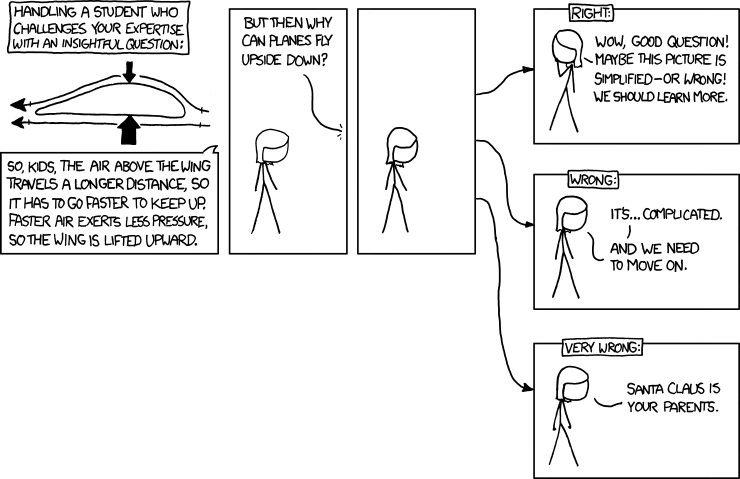
The cartoon is, of course, xkcd.


READ MORE - Faith and fear

More "New Jersey World Class Standards"


5.2.2.A.2
By the end of Grade 2:
Identify common objects as solids, liquids, or gases.


Throw plasma in there, the most common state of matter known in the universe. You have common examples in the classroom, the incessant hum of fluorescent lights above. You have great examples outside, the sun and the stars. Some students may have plasma televisions at home.

How many teachers have been tripped up by this "simple" question: what is the sun made of?

If you want to keep a state of matter up your sleeve, save the Bose-Einstein condensate for high school.

5.2.4.A.3
By the end of Grade 4:
Objects and substances have properties, such as weight and volume, that can be measured using appropriate tools.

I spent weeks teasing apart weight and mass in a freshman science class. Mass is, at this level anyway, the amount of matter (call it "stuff") in something.

Weight is a measure of the force of gravity on the stuff you are measuring. It depends on where all the other objects in the universe happen to be at that moment, since everything is pulling on everything else.

The closest huge ball of stuff is the Earth, so weight and mass seem synonymous.


They're not--your mass does not change on the moon, but your weight does--but you knew this already. Even 2nd graders know this. You can show them astronauts jumping around the moon and ask them why they can jump so high. They'll parrot the standard answer ("less gravity").

I suspect most of us are afraid to touch gravity because we just plain don't get it.

I would love to start the year with a class full of young adults who get that we don't get it.
That's how science starts.

Really.....


The states of matter graphic comes from Chem4Kids.com.
The moon clip from YouTube, uploaded by Amontai Yagala
READ MORE - More "New Jersey World Class Standards"

Acid Rain the rising destruction to our natural living

Acid Rain
Acid rain, one of the most important environmental problems of all,and the fact which cannot be seen naked. The invisible gases that cause acid rain usually come from automobiles or coal-burning power plants(all is in our hand).


Causes:
The primary causes of acid rain are sulfur dioxide(so2) and nitrogen oxides(No). These chemicals are released by certain industrial processes, and as a result, the more industrialized nations of Europe as well as the US suffer severely from acid rains.

Most sulfur dioxide comes from power plants that use coal as their primary fuel to operate. These plants emit more than 100 million tons of sulfur dioxide,which is about 70% of total caused in around the world.

Its only the Automobiles which  produce about half of the world's nitrogen oxide. As the number of automobiles in use increases rapidly , so does the amount of acid rain too increases enormously. Power plants that burn fossil fuels also contribute significantly to nitrogen oxide emission.(we can't stop production 4 tht)

Natural causes also exist in adding these gases to the atmosphere. Fires, volcanic eruptions, bacterial decomposition, and lightening also greatly increase the amount of nitrogen oxide on the planet.But you know,even a gigantic explosion made by a volcano is only equal to what one coal power plant produces per year..!!! Think how much we the human took part in this competition..?

Acid rain comes down to the earth in the form of rain, snow, hail, fog, frost, or dew. Once it reaches the ground, the acidity in the substance can harm and even destroy both natural ecosystems and man-made products.such as Cars finishes,etc..

Effects:

Because it is mainly caused by industrial processes, automobiles, and power plants, those countries that are developed have the most severe acid rain problems. However, as the undeveloped nations begin to industrialize to reach its goal of developed nation(isn't it..?), acid rain will increase greatly.

Many ecosystems are affected by acid rain. Bodies of water, such as lakes and rivers, see many of their inhabitants die off due to rising acidity levels.Acidic water also ruins some of the plant nutrients, hurting plants' ability to survive and to give life to other organisms.Human-made products are also experiencing degradation from acid rain. Cars can lose their finishes, and outdoor statues are beginning to rust.

Solution:
It is because of Human,so only Human can implement methods to reduce the acid rain.Businesses such as power companies and car makers oppose controlling acid rain because they fear the effects on their profits.They can use coal with a low sulfur content, they can remove the sulfur from smoke their plants release, and they can limit processes known to generate high levels of acid rain.Environmentalists advocate the installation of sulfur cleaning scrubbers in factories, washing sulfur out of coal, and finding new methods of burning coal. Power plant operators are looking for less expensive solutions to the problem.Individuals can help by conserving energy or driving their cars less. Governments can pass laws restricting pollution levels.It have to be strictly reduced in the future to live ..!!

if you like it,jus share it...help to reach everyone n make awareness!!!
READ MORE - Acid Rain the rising destruction to our natural living

Microwave map of Moon revealed

The Entire Microwave  map of the moon has been revealed by Chinese satellite.
 

During Day Time Temperature of the Moon


During Night Time Temperature of Moon


READ MORE - Microwave map of Moon revealed

A Bee can Detect your diseases

You might have heard of dogs that can detect diseases in humans beings.Thats the word you can say it for bees too,ya ,now bees can also be trained to do it too.

We know Bees have good sense to smell anything,with this fact in mind researcher Susana conducted to smell Human air using Pavlov's reflex, bees can be trained within minutes to detect specific disease-revealing odours in people's breath.

Susana Soares has developed a strange-looking glass apparatus that you breathe into, while bees in a separate section of the bowl react to what they smell
bee fly,sniff,detect diseases,glass,apparatus,susana


Just if we breathe into Susan's Strange looking Glass apparatus,bees that kept inside the separate dept can detect your body medical conditions like lung and skin cancer,tuberculosis and even pregnancy.

Since our honey-making friends learn quickly and travel long distances with ease, they might someday be called upon in fture to sniff out bombs and landmines,too..
READ MORE - A Bee can Detect your diseases

Cockroach Brain have Antibiotics

cockroach,image,brain,artist,antibiotics,


You may scared of cockroach or it may make you crawl,but their Brain could one day save your Life.

Ya,it's because the central nervous systems of American cockroaches produce natural antibiotics that can kill bacteria which often deadly to the humans,some of the bacteria's such as methicillin-resistant Staphylococcus aureus (MRSA) and toxic strains of Escherichia coli, scientists from Simon Lee of the University of Nottingham in the U.K said this week.

Insect Brains Have "Clever Defense" Against Bacteria.
The scientists found the bugs had antibiotics only in their brain tissue, the most essential part of the body,When the team added the insect's antibiotics to human cells in the lab,there were no toxic effects.
It says insect-brain drugs for humans are still years away.
READ MORE - Cockroach Brain have Antibiotics

Ring of Fire


Something happened about 14 billion years ago, or so our version of the story goes. Something happened, maybe from nothing, and here we are now. Someone much like me will likely be here long after I die.

That is the heart of the story. Entropy drives the drama.

I am too wrapped up in life to get hung up in existentialism--a quick peek at a patch of ground teeming with critters reminds me that rejecting anything human does not end the universe.

So while I keep trying to bring my lambs back home to the bigger story that drives science, I often fail when navigating through membranes and enzymes and all kinds of minutiae I am paid to impart.

Johnny Cash knew biology. Willie Nelson still does, and he lives it--you can fill up your truck with BioWillie Fuel.

We love for a lot of reasons, and we do not talk of love in biology for far fewer reasons, but when you get down to it, the business of spilling ourselves into others involves respiration and reproduction. Love is indeed the essence of evolution.


And all along the way, oxygen ultimately rips electrons from sweet sugar, reducing life back to water and carbon dioxide and heat, the same theme in Shakespeare's sonnets and in lurid dime novels. We're all driven by a slow form of fire.

Just ask anyone paying attention.


For the Social Distortion version, take a peek here.

My wife once walked on window ledges, I once pushed motorcycles to their limits.
We fell in love, survived anyway, and now we tell stories.

Mary Oliver wrote "Oxygen," a poem, one of my favorites.
I originally saw it in the New Yorker--you can find it here now.
(Thank you, lucychili!)

READ MORE - Ring of Fire

Another bird story


I never saw a wild thing

sorry for itself.
A small bird will drop frozen dead from a bough
without ever having felt sorry for itself.


D.H. Lawrence


I regularly check on Patrick Higgins' blog, Chalkdust101. He writes well, consistently. His latest got me brain roiling, and here's the result.

But first a bird story.

Most people, if pressed, would tell you that birds, at least the wild ones that go mostly unnoticed outside, instinctively fear humans.

Now I do not doubt they fear us, and with reason. I do doubt, though, that it's instinctual. You don't buck instinct.

I spent most of today digging out the driveway. We have almost three feet of snow that never happens down here. While rescuing what's left of the rosemary bush (with its ridiculously optimistic purple flowers looking bright against the snow), I exposed a tiny patch of earth.

A robin hovered nearby.

I turned around to grab another shovelful of packed snow, then when I stepped to throw it over to the side, came this close to stepping on the robin snooting around the dirt. It flew a few feet away, not far, and waited for me to grab another shovelful.

Had you seen us from a distance, you'd have thought I had brought my amazing trained parakeet outside to help me shovel.
***


Higgins' most recent post has a brief TED talk towards the end. You can tell its a TED talk even without the video--the speaker has the bright, bouncy voice of someone interested in their subject yet educated enough to tailor it just so for the audience. TED talks are the Chautauquas of the net--content matters, of course, but performance matters more.

Jump to 2:40:


We now have a generation or two of children (and not nearly all of them, to be sure) who value the recording of an event more than the event itself.

One sad scene in the clip shows a young woman taking a picture of her kissing her beau. Sad because she's wasting the use of a perfectly good hand. Even sadder because she is removed from the moment.

If you're going to share, really share, a passionate kiss, you're eyeballs should feel like they're going to twist inside out. Time drifts away. Touch blends with smell and warmth as self-awareness melts. No time. No self. Just. This.

The only reason a kiss is worth photographing is because of the stuff we cannot see--we can only hope to imagine the infinite moments. If you're multitasking during a kiss you've missed the point.

My robin may not have much self-awareness; really no way to tell. He did have, however, a splendid understanding of his situation. Hunger refines interests and awareness of the moment.

If it had instinctual fear, it would not have weighed its hunger over the large mammal carrying a shovel no more than a foot or two away.
***


So why do we record anything? Why write?

There's a danger when we let the story, the picture, replace the moments when we lose self to a broader sense of awareness. Humans have only recently mastered the written word, a Faustian bargain.

We create stories to help explain our (in a broad sense, not the limited ego factories we've become) place in the world. It's a confusing place. Even a simple walk outdoors overwhelms our imaginations when we pay attention.

And, of course, we die. Words and photos do not. We place an awful authority on the things that we think define us beyond our lifetime. Alas, we think wrongly.
***


I've lived a charmed life--flying off motorcycles, working on the docks of Newark, in Athens right after the earthquake, practicing medicine in the projects.

I have many stories in a clan that of folks who all lived charmed lives. When we get together as the sun sets on a late June evening, we share our stories, reframe them, shaping them for the next time we share a sunset.

But the stories are not the lives. They are reminders that we all live charmed lives, that none of truly grasp what the world brings to us, and that we like sharing the sound of our own voices.

At the end of the ferry jetty, the waters swirl in a large eddy as the tide ebbs. Cormorants seek fish tumbling in the odd currents. I see them surface briefly, occasionally with a writhing flash of silver in their beaks, and imagine what they know.

Imagine the cormorant as it plunges into the gray-blue shadows looking for flashes of silver, then feeling the writhing of muscle in its beak.

But, of course, we cannot--if we create the story as we live it, we lose it.

And when I find myself outside putting together stories, I stop. I am not the story. My death will not be unique. My clan will continue to live, and tell stories, hopefully for thousands more years.

And when I start to put the stories ahead of the living, I stop telling stories until I remember what matters.
***


I teach science. Science is all about creating myths, in the broad sense, to help explain our universe. For science to work, we must pay attention to the universe, or else it's no longer science. That's not to say other kinds of stories are pointless, but it is to say that stories can (and do) get in the way.

The hardest thing about teaching science in a public school under a curriculum dictated by committees is that many of those in charge of science education act as though the stories themselves are what matter most.

Memorize this theory, that equation-both are special kinds of stories that help us grasp what we see. Too many children, even (or maybe especially) the bright ones, confuse the story for the universe.

The universe is ultimately unknowable to creatures like us. A good story gets us closer to the truth, but cannot replace it.


The amazing cormorant shot through the Seafloor Mapping Project.
READ MORE - Another bird story

Algorithms for Algernon

OK, this is a long one, mostly scattered thoughts written on a snow day, after reading The Mayor of Casterbridge for the last time. It's mostly for me. If you want to come along for the ride, bring a steaming Thermos of coffee.

People degrade themselves all the time in order to make machines seem smart. Before the 2008 stock-market crash, bankers believed in supposedly intelligent algorithms that could calculate credit risks before the bank makes bad loans; we ask teachers to teach to standardized tests. We have repeatedly demonstrated our species' bottomless ability to lower our standards to make information technology good, but every manifestation of intelligence in a machine is ambiguous.

Jaron Lanie, Harper's Magazine, February, 2010


I find it fascinating that as information becomes cheaper, we worship it more.

***

There's value in owning things in your mind, as opposed to relying on social networks or Google or Wikipedia. The brain does not work in programmed algorithms. We screw up. Ideas mutate. We make leaps and bounds that often fail, but occasionally resonate.

There's value in owning things in your mind. You cannot connect ideas, or things (thank you, Dr. Williams), lying loose all over the place. You can only shuffle file cards so fast, you can only link so many web pages before losing the gist.

We are privileged to have sensations, neural connections to this world, and a brain to know it, so far as it can be known. The machine is the product of an imperfect animal. If there is perfection, it lies outside the machine.

In Thomas Hardy's time, scythes and hay-rakes and mattocks ruled the countryside. No electricity, no phones, and social networks were formed at pubs. The economy of Casterbridge depended on the earth--livestock, corn, wheat, and all the labor and tools that went into reaping what our land can grant us.

Despite our conceits, our algorithms, our nanosecond technology, the gifts of the true economy have not changed. We still reap what we sow. We still eat and shit, we still woo and reproduce, we still depend on others. That the others are now strangers and driven by profit and not love has changed us, for now.
***

Bacteria communicate with each other. They have different signals for those of their own kind, and share universal signals with other clans/species.


Squids "talk" through light. Humans "talk" through smell.

Nothing can replicate the utter joy and sorrow I felt seeing the eerie dying glow of a comb jelly on a warm August beach, so contrary to what I know that I could not see it for what it was. Until my imagination exceeds the possibilities around me, I'll trust my thoughts, my clan's stories, our collective, flawed understanding of a world that exists before I plunge into the grid that frames a limited, knowable world.

(And I will add the story of the "talking" bacteria....)
***

I see bright senior high school students struggle with basic tasks subsumed by the network. Seniors who cannot look words up in a dictionary. Seniors who "know" calculus, but cannot solve simple arithmetic problems.

These are among the kids that will easily pass the state exam.

I suspect (or rather hypothesize) that most folks in charge of detailing curriculum at higher levels do not grasp science. Or perhaps they grasp science but are under unprecedented pressure from the Feds to ignore what they know and develop something that results in more money.

I get that real biologists need to speak a common language, a professional language, to communicate cogently and efficiently to fellow professionals. I get that kids need a basic understanding of the language of science to grasp (and critically assess) the technical leaps and bounds now more dependent on profit than promise.

Most of my students, however, need to grasp how science works. We are creating a generation of children who look cute spouting off big words and phrases, yet do not wonder why a light goes on when you hit a switch.

We need to cultivate wonder.
***

Our former Superintendent told the teachers, publicly, that it does not matter what we think about NCLB, it's the law, and we must comply. Had he said that 8% of our budget depends on Federal funding, and that the district has weighed its options and decided that imposing certain tasks, odious (and ultimately useless) as they may be, matters more than the value of real education, well, I'd have more respect for his decision.

Mr. Digesere was a music teacher before he was superintendent. Lucille Davies, our prior Commissioner of Education, is a lawyer whose teaching experience was as a Confraternity of Christian Doctrine (CCD) teacher at her local parish. Bret Schundler, the new guy, cut his teeth over at Salomon Brothers, and most recently was COO of The King's College, so at least he's rubbed shoulders with educators.

Don't get me started on Arne....

All believe in the algorithms, believe in the standardized test, believe in an infinitely growing economy if only we can find the right algorithm. Pick any wonk in control of education policy today, and you'll get the same results. Growth. Standards. Competition. Economy.

I'd bet a 6 pack of my best home-brewed mead that none of them could explain respiration or photosynthesis or meiosis, or even half the things dictated by the 2009 state standards. (I would really like to hold on to my 2008 blueberry melomel--only 20 bottles left--but I've no doubt they're safe with this offer.)
***

If you're a bit stir crazy today, go out and find a tree. Trace its branches. Imagine the wind, the light, the forces that shaped that tree.

No two trees have exactly the same branch pattern--the tree's branch pattern tells a story of seeking light, or bending to wind, of battles with bugs and fungi and and perhaps lightning or a child's tree fort.

Two acorns with identical DNA will produce two very different oak trees--trees are designed to respond to their environment. Each new branch arises from a complex combination of triggers. Each tree is unique.

Humans and trees share a common ancestor. We have errant children--one of the joys and frustrations of a functioning classroom. I need the to pass the state exam, and I want them to learn science.

We are going to learn the hard way that the true economy is based on life, on the dirt we walk on, on life itself. I plan to keep on teaching science. It's what I'm paid to do.
I am going to a conference March 1, sponsored by the New Jersey Dep't of Education. I am dragging along a fellow biology teacher, almost as cranky as me, to Module D: Aligning Biology Curriculum to the End-of-Course Assessment. (I have no idea what "Module D" means, but it sounds, um, serious....)

Read the title of the workshop--we have put the cart before the horse, an analogy that no longer works in a universe of bytes instead of bits. We are expected to align the course to fit a limited exam that must fit within a class period or two.

If I had to test my lambs on whether they grasped anything new this year, I'd give them a few pill bugs, access to the various pieces of equipment in the classroom, and ask them to learn something about their behavior. I'd expect them to develop hypotheses, and set up replicable experiments. I'd hope they can examine evidence. And most of all, I hope that when they're done, they realize how little they can know about a pill bug trapped in a Petri dish, how little they know about anything.

I'd furtively trail them as they walked home--and if one lifted up a rock to find another pill bug, they pass.
READ MORE - Algorithms for Algernon

Electrostatic magnetic ion attraction: The ADE 651

A story ran in the New York Times claiming that the Iraqis are using divining rods at checkpoints--a "small hand-held wand, with a telescopic antenna on a swivel" can apparently detect bombs.

Since the device employs the principle of "electrostatic magnetic ion attraction," it must be effective.

I'm still not convinced this is not an April Fool's prank with a calendar problem, but I guess if the world's leading expert on bombs (just ask him) tells you a divining rod can detect bombs a kilometer away (as well as ivory and truffles) and only costs $16,000, well, I got to have one!

It's worth it for the truffles alone.
(Do you have any idea how much it costs for me to maintain Snuffles my truffle pig?)

OK, this is too easy, and I figure a lot of bloggers will jump on the obvious, but that's not what I want to talk about.

I want to talk about our military's response:
“I don’t believe there’s a magic wand that can detect explosives. If there was, we would all be using it. I have no confidence that these work.”

Maj. Gen. Richard J. Rowe Jr, who " oversees Iraqi police training for the American military"
As reported by the New York Times, November 4

We tested it--we spent our hard-earned tax dollars and spent it testing a divining rod. Our DoD used the National Explosives Engineering Sciences Security Center at Sandia Labs to check out the claim.

And this is where I am supposed to sputter and spew about how tax dollars are wasted.

But I won't--because I teach science, and that is exactly how science works. You empirically test things. Especially things that are being sold to monitor checkpoints that might save the lives of our soldiers.

“Whether it’s magic or scientific, what I care about is it detects bombs”
Maj. Gen. Jehad al-Jabiri
Head of the Ministry of the Interior’s General Directorate for Combating Explosives.
NYT, November 4

Go us! Despite our love of psychics, astrology, and Dr. Phil, our military still practices science.

If the Iraqi government wants to stake its citizens' lives on magical devices, that's their business. If they want to risk our soldiers' lives by ignoring science, that's ours.

Time to find a magic carpet and get ourselves home.


READ MORE - Electrostatic magnetic ion attraction: The ADE 651

A Topologist's View of the Body

Perchlorate is an an interesting compound. It's found in air bags, some lubricants, mortars, and rocket fuel. It's also found in human breast milk.

Perchlorate is present in virtually all milk samples, the average concentration in breast milk is five times higher than in dairy milk....The presence of perchlorate in the milk lowers the iodide content and may impair thyroid development in infants. On the basis of limited available data, iodide levels in breast milk may be significantly lower than it was two decades ago. Recommended iodine intake by pregnant and lactating women may need to be revised upward.

Andrea B. Kirk et al.
"Perchlorate and Iodide in Dairy and Breast Milk," Environ. Sci. Technol., 2005


Ah, another environmental fountain of words. More sated Westerners, conquerors of the planet, seek to fight the good fight, to "protect" the environment, this soup we live in.

Maybe you're interested because your mother has breast cancer, or maybe you feel a little threatened by terpenes in your water. You're minding your own business, yet now you have to face some messy nonsense in this "environment."

***

Swallow a long string. Keep feeding the string as it passes through your gullet. Eventually it will pass out your anus. You can tie the two ends, forming a nice loop. You are topologically related to a doughnut.

(Actually, given the holes in your nose leading to the pharynx, the holes in your nasolacrimal ducts leading to your nose, and the assorted other sorts of holes in your body, you are a bit more complex than a doughnut--we're closer to pretzels.)

It's easy enough to see one as a doughnut still separate from one's environment. Keep your mouth closed, your butt tight, and you can maintain a sense of identity.

Indeed.


Think of a cell deep in your body. The only qualification is that it has to be alive. Let your mind meander to 3 centimeters inside your liver capsule, or maybe you prefer thinking about a kidney cell nestled deep in your back.

If it is alive, it respires--sugar combines with oxygen, heat and motion result.

Life.


We think of ourselves as separate from the environment, and that is partially true, at least at macroscopic level. Still, you must join in the global party of life, consuming bits and pieces put together by sunshine, or you cease to be.

The surface area of your skin is about 2 square meters.
Your lungs? About 100 square meters.
Your gut? 300 square meters.

While our Western sensibilities balk at this sort of nonsense, the rest of our body wants to be exposed. 400 square meters of you wants to absorb air and sugars and proteins and water. You have giant sails of mucous membranes specialized in absorbing anything and everything around you.

Meanwhile, you spew off methane and carbon dioxide, urea and heat.

To say you live "in" the environment confuses the issue. Don't let your skin define you.


Go with your gut.


READ MORE - A Topologist's View of the Body

Acorns and oak trees and Arne Duncan

On October 4, 1957, the Soviet Union launched Sputnik. In 1958, Eisenhower signed the National Defense Education Act, a bill in which Congress wanted to assure the "fullest development of the mental resources and technical skills of its young men and women …."

While scientists were busy developing phenomenal ideas that questioned pretty much everything (which is what scientists have always done, and often gets them in trouble), the Federal government confounded science with technology and took control on how certain monies were spent in education. (It threw in a loyalty oath for good measure.)

The division between science/technology and the other arts continues to dominate schooling. Lumping science and technology together reflects our pedagogical confusion and drives the science curriculum. I am required to "teach" kids who cannot connect an acorn to an oak tree how DNA technology works.
***

When I was in school, teachers cautioned me against anthropomorphizing. I would make an observation--"my dog smiles"--and get back a declaration--"that's anthropomorphizing, it's not really smiling." So I learned to change my language for the same observation.

"My dog pulls back its lips in a way that resembles human smiling." Only humans could feel, well, human.

I still say my dog smiled. Turns out I may have been right all along. Even mice recognize pain in other mice, and it influences their response to pain. It's even more pronounced if the mouse knows the other mouse experiencing the pain.

Don't call it empathy, call it "emotional contagion."

Two ways to take this--either humans are not as special as we thought, or maybe more things are special than just our branch of primates.

Meanwhile, I teach about DNA technology in class while the lunch ladies two stories below me lovingly slap slabs of mammal meat on bread made from the least nutritious part of wheat to serve to the same kids that don't know an acorn from an oak tree.

I recognize that knowing an acorn from an oak tree won't help my kids compete in the global market. I suspect it will help them lead happier lives.

What to do, what to do....
***

Two years ago I made a loaf of bread mixing a few wheat berries grown by the kids on a windowsill with the wheat berries I keep at home.

The bread was delicious, and most of my lambs enjoyed it. A few, however, were put off by the idea that their breath had anything to do with the bread they were now asked to share.

Communion took on a whole new angle.

Communion is an old word, and comes from communio--mutual participation. Communion is about sharing.

The lunch ladies love their charges. Josephine calls me Pumpkin, and I may even be a little bit in love with her.

Josephine does not know where the meat comes from. I don't expect that she should. She serves it with love, I eat it.

I know better, but I do it anyway.
***

Mr. Arne Duncan, our United States Secretary of Education, believes that we must prepare our children for a global economy. He speaks in tongues.

Yesterday he said:
I grew up on the South Side of Chicago working and living with young children of color. These kids were threatened every day. They lacked role models to protect them and guide them to a safe place where learning was valued and rewarded."

I get nervous with the "these kids" crowd. I get nervous with people who wave contact with people of color as some sort of credential. I get nervous about a lot of things.He didn't mention where he went to high school.

I especially got nervous about this:

Finally, I am very excited about a $15 billion "Race to the Top" fund approved by the House. The Senate version is somewhat smaller but it is still significant.

The President is deeply committed to this program because it will enable us to spur reform on a national scale—driving school systems to adopt college and career-ready, internationally benchmarked standards.

It will incent them to put in place state of the art data collection systems, assessments and curricula to meet these higher standards.

I am going to go on record here stating I do not believe internationally benchmarked standards are a good idea. We need locally benched standards (such as distinguishing an acorn from an oak tree) before throwing the rest of the universe in. I will gladly throw in eucalyptus trees once my lambs have a handle on acorns.

And please dear God please tell me he did not say "incent."

We don't need a race to the top. We need collaboration and cooperation and (dare I say it?) love.

(It doesn't help that Mr. Duncan chose to make these comments at my neices' high school--thankfully they are both thoughtful, independent thinkers, neither of whom use the word "incent." Hi Karlyn, Hi Claire!)

***

Arne Duncan was a professional basketball player. A bright (but not as bright as he thinks he is) athlete who never taught.

I never taught in public schools, either, before 2005. I have almost three more years teaching than Mr. Duncan. I have not taught enough to be any kind of administer in education (and for the record, have absolutely no interest in ever becoming administer), but I have taught more than the current Secretary of Education.

So here's the quandary. I want to teach our children about acorns and oak trees. I want them to know about the Second and Third Rivers in Bloomfield. (We, inexplicably, do not have a First River.)

I want my lambs to know that the beef they eat in the cafeteria has been expediently raised in circumstances less than stellar, and that there is a real possibility they sense things recently attributed to humans only.

I want my students to connect their breath to bread, to life, and back to bread again (because their breath is connected to bread and to life).

I want my Secretary of Education to use real words.

And he wants me to start using international standards.

You cannot know what matters until you know what is happening under your nose. Give me a year with my kids and they will at least know that much.

Give me a year teaching international standards before my kids know an acorn from an oak tree, however, and they will know nothing. No matter how employable they may be (should there be any jobs left for them to find).


The bread was made by Jessica Pierce--I owe her (yet) another horseshoe crab. She likes naughty words even more than I do, so click at your own risk.

DDE is public domain.


READ MORE - Acorns and oak trees and Arne Duncan

Clay Burell, Quaker meetings, and knowledge


I am a huge fan of Clay Burell, now over at Change.org; he also has a wonderful blog Beyond School where he attacks schooliness and ragged thinking while bringing to life classics such as Gilgamesh.

He recently posted a (justified) attack against a recent Science Daily article that highlighted a study that suggested that newer technologies had a hand in declining critical thinking skills. It's worth reading.

Still, the disciples of the high tech crowd did not disappoint this "reactionary clock-turn-backer" with their crowing. So I responded.

I wanted to carry a small piece of my words back here:
It's been awhile since I sat in a Friends (Quaker) meeting. The local meeting is unprogrammed, which means we sit silently for an hour or so. Occasionally someone will speak if so moved, but most times little (blessedly) is said.

The first few minutes I am incredibly twitchy, and cannot settle down until I remember I cannot settle down by trying, then am content to watch the sun beam creep across the bench in front of me.

I stare out a window looking at a tree. A few telephone lines run by it--I think about the tremendous amount of information that passes through those lines every minute. Then I think about the tree.

Both are marvelous things, the human wire, the mystery of trees, and both hold vast amounts of knowledge. The wire is ultimately knowable, the tree ultimately not.

I'm more interested in the tree, because it's more interesting.


The tree picture is from the University of Florida Urban Forestry program found here.
READ MORE - Clay Burell, Quaker meetings, and knowledge

An irreductionist looks at yeast

This is science:
Yeast have over 6,000 genes. More than half of these genes resemble human genes.

This is technology:
Some mutant yeast genes can be replaced by human genes with similar function. The yeast cell then acts normal again.

This is what happens in my kitchen:
I add a few billion yeast to flour, water, honey, water, olive oil, and salt. They play like mad, reproducing, blowing off carbon dioxide. I then slaughter them in the oven.

I add a few billion yeast to water, malted barley, and hops. They play like mad, reproducing, blowing off carbon dioxide. I put an air lock on brew bucket. My yeast use up the oxygen, switch to alcoholic fermentation, poison themselves with ethanol, and go dormant.


Science is about what we can know through direct or indirect observation; it requires a reductionist view of the universe. (Well, OK, the physicists are busy studying God, but for the rest of us....)

Science is a very powerful tool, and what we do with our knowledge (technology), has warped our world in ways we could not have anticipated.

If we teach reductionist thinking as the way to think, as we do in science class, we lose too much.

***

I have no idea what it feels like to be a yeast cell, and I have no scientific way to figure it out. I know they do not have legs, or eyes, or teeth, or brains, so I can safely presume that their existence hardly matches my own. While scientists play with the yeast genome (fully mapped out in 1996), comparing and contrasting their nucleotide sequences with our own, they have no interest in what it means to be a yeast.

Oh, a chemist may well wax philosophic on her yeasties as she bottles her finest homemade cherry stout, but she's not going to pretend that anything scientific will result from her musings.
***

I am nutty enough to rinse out the yellow Munton ale yeast package so that the few remaining thousands (millions?) can be released in my backyard. This is madness in a reductionist universe, but offers comfort to my irrational side.

(What word does a public school science teacher dare use for "irrational"? Superstitious? Mystical? Crazy? Traditional? Cultural? Religious?)

In science class, I am careful about wandering into the irrational world. I do have an imaginary leprechaun wandering around Room B258--he serves to remind us of what defines the "natural" world--but I am not going to launch into some existentialist babbling about yeast in my classroom.

I do, however, make a point about the distinction--when we wander to the edge of reductionist knowledge, I will tell the class that some things are unanswerable by science.

How do you handle the questions that take you to the edge of rational knowledge?

READ MORE - An irreductionist looks at yeast

Mitochondrion

Part 2 of the last post.
I may have posted this already.


In 6th grade, you labeled your cell diagram, not quite understanding what you were doing, but enjoying picking the colors from your box of crayons, coloring the pill-shaped organelle a Crayola cadet blue.

In 8th grade, you learned that the mitochondrion was where oxidation and the Krebs cycle took place (even though oxidation and Krebs were just sounds to memorize to please the teacher). You learned that this was the cell's power plant. You imagined a tiny engine burning gasoline.

In high school you memorized the Krebs cycle, took the Biology AP Exam, and managed to slip into a decent college. You slogged through biochemistry, and eventually became a pharmacist.
***

Mitochondria reside in our cells--they are sort of us, but not really--they carry their own DNA, and they descend from other mitochondria carried by your mother. And her mother. And her mother's mother.

Coloring them was about as exciting as mitochondria ever got.
***

Three decades ago I sat in the auditorium of the American Museum of Natural History. The teacher had primed our class, so when the serious man on stage asked what energy was, I knew the right words to say.

I raised my hand.
I started to open my mouth--I knew the words, my teacher was already smiling.

I did not say them. I stared at my feet.
"The ability to do work" caught in my craw.
The words explained nothing to me, and still do not.

My teacher's disappointment was once enough motivation for me to answer a stranger's question, even if I did not understand my own words.

At least until 6th grade.
***

Oxygen combines with fuel to release energy--light and heat. The oxygen does not contribute to the energy released--it "simply" accepts electrons, allowing bonds to break and reform.

If this happens fast, you get fire. Oxygen grabs electrons and protons, forming water. Hold your hand over a barbecue--the moisture on your palm is not just sweat. Hold a glass beaker over an open flame--water condenses on the cool glass. Try it.

Oxidation can happen slowly, too. The rusting rims of your child's bicycle left out over winter warms the frigid air as metallic iron morphs into ferric oxide. Rust releases heat. Molecules vibrate more quickly as electrons shift.

I know the words, but still do not trust them.

In 1978 I shoveled iron turnings on the docks, my feet warming up despite thick work boots. Until then I did not believe that rusting iron releases heat. Even more important, I had no reason to believe it--I no longer trusted teachers.

My favorite students are those who do not trust my words now--"show me!"
And I do.
***

The warmth and movement of your lover comes from the sun.
You twist together, heat and motion.
Mitochondria hum.
***

In the morning, the sun rises, as it has, as it will.

The apple I eat courses through my veins as sugar, sugar that feeds the mitochondria.

Heat, water, and carbon dioxide are released. I step outside into the New Year chill, and see my breath. The water vapor dissipates, to return as rain. The carbon dioxide eventually feeds the spring garden, a few molecules going back to the apple tree, where the sun's energy restores a bit of order.

Leslie and I make up our shared bed, laughing at the entropic knot of sheets and blankets.

Our body heat comes from our mitochondria, trillions of symbionts stoking our fires.

If the soul resides anywhere, it resides here in the mitochondria.
After our last agonal gasp, our corpse quickly cools. The change is startling, even to experienced hands.

I've pronounced a lot of dead people, feeling for a pulse, watching for chest movement. Either can fool you. The abrupt onset of cold, however, tells the story. The mitochondria have stopped working.

You are dead.
***

The best parts of science get buried in the details.

Nicotinamide adenine dinucleotide.
Adenosine triphosphate.
Alpha-ketoglutarate pathway.

My students yawn at the details.

I try to use a 3D model. Nitrogen atoms are, alas, painted blue.
"The red balls are oxygen, the blue balls...."

My frontal lobe edits too slowly today. I have their attention now--"Blue balls, he said blue balls!"--and the room now vibrates with a different kind of heat.
***

I breathe. I eat.
I use the energy released from the food I eat today to start preparing for the spring garden.

A garden is a lovely lie--a pretense of order in the midst of organic chaos.

I teach about the Krebs cycle in a classroom without windows.
I want to stop class, run outside, show my lambs the inexplicable dance outside, where a tiny portion of sunlight happens to hit our world, and carbon dioxide and water happen to get reorganized into food, that we happen to eat, to be.

Grace. Dharma. Science.


READ MORE - Mitochondrion

What I know now....

If I am going to pretend to be an edublogger, I need to toss an explicit post on teaching now and again.

I've been observed 3 times this past week; either I'm wowing them or they're looking for the bodies. This is my third year. I'm up for tenure.

One of the tragicomedies of American education is the tenure system. This year an innocent comment misinterpreted by a 14 year old can get me looking for a commercial clamming license. Next year, once tenured, anything short of a felony in the classroom (and even then it's even odds) won't warrant the time needed to get me booted.

So I enjoy the parade. Worst comes to worst, I sling a stethoscope around my neck and start succoring the afflicted again.

So, a list. Bloggers love lists.

Here's what I know as a 3rd year teacher I could not possibly have known as a greenhorn.


1. No matter how much you sweat you put into a lesson, it is not the students' obligation to appreciate it.
We've all been there. We put together the lesson of the century, a lesson that would make John Dewey misty eyed.

You spent $126 on the materials.
You have an anticipatory set that could waken your long-dead great grandmother.
You spent 27 hours preparing the lesson, the glow of the monitor highlighting your maniacal grin as you fantasize about the anticipated eagerness of your lambs eating up your lesson.

You forego tickets to the 7th game of the Rangers/Devils Stanley Cup playoffs.
You turn down Willie's invitation to travel for a week on the Honeysuckle Rose.
You even stop playing solitaire.

You are a freakin' professional!

And the kids yawn. In your face.

Welcome to teaching. It's not about you.

2. Stay out of the teacher's lounge.

No, really. It's a trap. If you need to complain, you need to get out.

It's a great field. You get to teach children. You mold future citizens. You get to see a side of children even parents never see.

It's a gift, an honor, a raison d'etre. ( Feel free to add the circonflexe--I'm a Luddite.)

It's easy to complain about the hours (no longer than a laborer picking grapes) or the respect (no less than the security guard sitting in the lobby of your school) or the students (you want to work with humans, you're going to get human behavior) or the pay (hey, I make more per hour as a teacher than I did as a doc).

The lounge kills hope. You need hope to teach.

3. Textbooks are like crutches...wonderful if you need them
Textbooks can save your life (but not your soul) that first year, when even the mere act of micturition requires three weeks of planning.

It gets better by the third year. Really. So much better you can now pee without consulting your calendar.

Textbooks are written by committees. Students don't need committees. They need you. Wean yourself.

If you don't believe this, go join a committee.

(A confession: I still spend too much time using textbooks--I'm working on it.)

4. Teach to the child, not the test.
Turns out the test just isn't that good, at least not around here. And I hear from other bloggers, it's not so go around there, either.

Ben Wildeboer (Sustainably Digital) notes that lousy tests "perhaps do serve a valuable purpose...."

When I start to feel myself get stressed about falling behind and not going over all the required content, remembering that the standardized tests will be poorly written and not do a great job of assessing the standards makes me feel better about not covering everything I’m “supposed” to.
Ben Wildeboer

The child will remain reasonably intact for the next few decades, barring a motor vehicle accident or HIV, or one of the amazingly rare reasons young adults die (but get great press when they do).

Tests, on the other hand, change all the time.

New superintendent? Reform.
New governor? Reform.
New President? Reform.

Kids are fairly stable--a couple of billion years of evolution are not influenced by the thoughts of the newest Administrator in Charge. Keep things in perspective.

5. Use what works, ignore what doesn't.
During my formative years, I had a couple of diametrically opposed adjunct professors. One was an elementary school teacher by day, the other a principal.

(Despite having a career in the "real world", I didn't go the alternate route. I took education classes before I tortured young adults as a student teacher. Nothing--and I say that without apologies--nothing can replace the student teaching experience for folks arrogant enough to believe they can teach.)

The principal had the proper accent and a better command of the language. She preened, she preached.

The teacher knew her stuff, but was not nearly as polished. Here's what she said.

If it works, use it. Put posters over the door to prevent snoopy administrators from peeking in, play the game, but teach your students. That's why you're there.

Never forget you matter.

Not all folks grasping the administrative brass ring are in it for themselves, but enough of them are that you need to interpret motives.

So I teach.

I see what works, and (painfully) dissect what doesn't. Tomorrow is another day. Keep plugging, keep analyzing, keep working, and keep your sense of perspective next to your Excedrin.

6. Keep your educational philosophy within an arm's distance.
I was warned.

There will be days when you wonder why you quit your day job to become a public school teacher position. There will be days when others wonder the same thing about you.

And there will be day's when your biggest doubter will be yourself.

So write that philosophical statement. Read it. Soak it in. Allow yourself to believe it matters. It does.

Keep it handy.

Read it again in November, when the words are blurred by tears, by sweat.

The day you stop believing what you do matters is the day you should quit.

7. Goal directed exhaustion is OK at times (if you don't make it a habit).
You chose this field.
Your field matters.
A hundred years from now, what you do today can matter.
Make it matter.

A few colleagues (usually found in the lounge) may tell you that you are working too hard, that you will learn the hard way, that you will burn out. A (very) few will even brag about never bringing home work as they physically fly out the door 10 minutes after the last bell, a door they flew out of spiritually years ago.

They're right--a lot of us will flame out. Honeybees work themselves to death, but they do worthwhile work.

You are going to die, too. Might as well do something special while you're here.


The Honeysuckle Rose shot is from an avid Willie fan, Linda, innkeeper of the
Stillisstillmoving blog. Wonderful pictures there!

The smoking teacher, the crutch factory, and tired doc pics are from the Life photo collection available at Google.
READ MORE - What I know now....