Late harvest

As I was poking around the classroom garden yesterday, getting the plants ready for the weekend, I found a pea pod dangling from a tiny pea vine.

The child who nurtured it will get "extra credit"--I used promises of points to get the some of my lambs 'interested' in putting dried peas into icky peat moss. She won't remember the points. She will remember the pod.


I hope she remembers the countless times she breathed on her hand--carbon dioxide and water released deep in her cells. Our plants are built on the carbon backbone of our exhaled breaths.

I do not pretend to know anything of God or gods. I enjoy reading the words of cultures past, to see what they saw when words were still so young that they were used carefully.

I can recognize grace, though--a pea pod given to us for the cost of our breath and a little bit of water.

***


I just came in from picking a few scrawny Brussels sprouts from very chilly plants--two of them now gracefully bend towards the ground, forming archways, seemingly honoring the earth that bore them, the last harvest of last spring's garden.

The sun is returning, slowly, so that our exhaled carbon dioxide can be used again, with grace.


 I can show the kids the graph above--the annual wobble in CO2 levels reflects the dance between the light of life and the ensuing darkness each winter.

Chloroplasts and mitochondria, ancient critters in cells that keep much of the living alive, work in tandem. Chloroplasts capture the energy of the sun in sugar, and mitochondria release the energy as the sugars tumble back to water and CO2.

A child feeds on the lies of our culture. Magic erupts from screens, voices erupt from wire. We are consumers on the infinite, and we tell the children lies because we believe them ourselves.

She memorizes the photosythesis equation without understanding,  because we tell her she must, in order to graduate, in order to get to college, in order to earn money, in order to eat.

A tiny pod just might put a tiny seed of doubt in her. It came from nothing, or so it seems.
It's tangible in a way photons can never be, no matter how thin the computer, how bright the screen.

***

So I will keep teaching about electron transport chains and ATP and things that can be tested with no more than a scantron and a pencil. I get paid to do this, and I enjoy it.

Our classroom garden provides the real lessons. Heads of wheat are erupting from plastic bottles, impossibly yellow squash flowers lean over plastic trays, and the peas keep wrapping themselves around everything in their path.

Not everything thrives--some of the children get quiet when their seedling wilts, a few get angry. There are always more peat pots and seeds in the back, and eventually another seed gets planted, converting our breath again to the living.

Biology.


Do not confuse grace with religion, nor technology with science. I know nothing. None of us do.
The veggies came from the back yard, the graph originally from NOAA
READ MORE - Late harvest

Bell jar

No, nothing metaphorical. The real thing.


I cleared out some space from one of our hallway exhibits to make room for our horseshoe crab art exhibit--a wonderful art teacher is integrating art and science, and the results have been lovely.

I took out an old microscope, a shark jaw (and the log-dead critter drew blood yet one more time), and a big glass bell jar.
***

Bell jars command attention, sometimes the wrong kind ("yes, Ralph, I realize it looks like a giant condom, let's get back to the lesson...").

I wiled away a lunch period with two other science teachers, trying to see how long we could keep a candle burning inside the bell jar, using various plants and light sources, ostensibly to create a nice demo for the kids, but the three of us were, well, having fun.

We "failed," or rather, ran out of time before we got a workable demo, and I'm sure we'll play with the bell jar again.

It dawned on me that there is little science in the demo.

"Look kids, no plants, candle goes out...." Kids stare for a minute as the flame dies.
"Look kids, lots of plants, candle stays lit..." Kids stare out the windows.

I would ask the obvious questions, then, waiting for the magical words, another science class liturgy, the teacher leading a communal response, another ritual without much thought.

***

For a few students, the demo could be brain-popping amazing, I suppose. For most, it cannot compete with the electronic looking glass resting in their pocket, a dopamine injecting machine, pure jolts of pleasure that does not diminish with dose after dose after dose.

Playing with a candle, a bell jar, and a couple of plants through lunch soaked my limbic system with dopamine. I would like my students to get stoked, too, but the joy comes from the discovery, not the finished product.

Because we lack time, because we have a state end-of-course exam, I rush through science as a bad history lesson ("We know this and this and this and this...."). Teaching science this way would be like an English teacher asking children to enjoy literature through SparkNotes.

It cannot be done.
We try to do it anyway.
***

The longer I teach, the messier it becomes, again not metaphorical.


Biology is messy and wet. At the end of each day my classroom screams entropy. Yesterday I picked up a remnant of fat left from sheep's heart on a lab table, rescued a couple of red worms abandoned in a Petri dish, and wiped off the Vaseline used to seal the bell jar on my desk. I put away the microscope used to show the soldier fly's compound eyes via the class projector. I tossed two peat pots left with dead seedlings--not all children care for their plants, and they die.

While my classroom gets plenty messy, my lessons may not be messy enough. I can show the bell jar demo in 5 minutes, or I can let go and let the kids figure it out themselves at the risk of broken glass, burned fingers, and Vaseline smeared all over the room.

So far I've taken the ostensibly low-risk, high efficiency  route, cradling "science" with demos that hold science in a bell jar, a few students watching the show, many just amused by any diversion in rooms of cinder block and white boards.

It's long past time to take the bell jar off of the lessons.


The doll heads in the bell jars photo was lifted from Eliot Glazer's post on urlesque here, permission pending.
READ MORE - Bell jar

November light

The last time these parts saw 9 1/2 hours of sunlight was the last day in November. The darkest 6 weeks of the year are over.

Amen.


Photons strike chlorophyll, electrons get pumped up, organic compounds grow. We need the sun. Not in a metaphorical sense.

Every breath you take, every thought you think, every sound you make requires energy, energy released when you break the bonds in the bread you eat.

The energy came from the sun, caught by plants, stored in bonds. The bonds get broken, our daily bread again reduced to (or, I suppose, oxidized, for you chemistry folks out there) to carbon dioxide, to water, the raw ingredients plants need for creating the stuff that ultimately creates us.

I cannot (and would not) presume to teach any religious creed in class. I do talk about this, though. Photosynthesis and respiration, molecules dancing together, joined together by the grace of sunlight, then breaking apart to release the energy within ourselves, energy needed to read these words.

The sunlight is returning. The days are lengthening.

And our lives depend on it.


Photo by Leslie.
READ MORE - November light

Faith and fear


For I took an Earthen vessel, in which I put 200 pounds of Earth that had been dried in a Furnace, which I moystened with Rainwater, and I implanted therein the Trunk or Stem of a Willow Tree, weighing five pounds; and at length, five years being finished, the Tree sprung from thence, did weigh 169 pounds, and about three ounces... I again dried the Earth of the Vessell, and there were found the same two hundred pounds, wanting about two ounces. Therefore 164 pounds of Wood, Barks, and Roots, arose out of water onely.

Jean Baptista van Helmont
Early 17th century experiment


That's how it works. You observe the natural world, take a stab at explaining it, and get it wrong. Van Helmont could have stayed on sure footing--the "stuff" of the tree did not come from the earth he used.

This week I am asking my lambs to memorize the photosynthesis equation. I have them breathe on their hands to remind them what "stuff" plants need for this (carbon dioxide and water), and the warmth of the breath reminds them that the plant needs energy to put the stuff together.

The warmth is sunlight transformed--to chemical bonds in plants, now to body heat.

The words "carbon dioxide" mean little to most, and many keep calling it "carbon"--I've broken a lot of pencils to show them what carbon looks like.

And yet I insist on teaching them that plants take it in on little more evidence than faith in me or in their fear of failing. Faith and fear may work for that old tyme religion, but it should have little place in a science class.

Which makes me a hypocrite--from the Greek hypokrites or "pretender" [Online Etymology Dictionary].
***

Van Helmont's experiment is wondrously flawed--he wanted to show that water feeds plants, but shoved 200 pounds of dirt between his willow and the water. He should have just planted the willow in plain water. (I learned this from David R. Hershey, who talks about this in a fun article "Digging Deeper into Helmont's Famous Willow Tree Experiment, " The American Biology Teacher, 1991.)

My students fear failure in class, and not irrationally. Failure kills students in public education.

We grow all kinds of things in class. Just this week, a child took home a fully formed carrot that grew in peat moss, fed by our breath and the water she gave it.

If I asked a very smart kindergartener how a plant grows seemingly from nothing, she might raise an eyebrow with an incredulous look--"It ate the water!"--how can a grown-up be so dense.

If I ask a sophomore, many will stumble, trying to give me sciency jargon. At least the kindergartner got it half right.
***

Unlearning is hard. My students have been blowing on their hands for 4 months now, since the first week, when we discussed why a candle (or anything else in the classroom) burns.

Over and over and over again I break things down into two categories--"stuff" or energy.

When you burn something, you end up with exactly the same amount of stuff you started with. Exactly, down to the atom. For all the light and heat and sound that erupt in from my lit propane torch, none of that energy cost an atom.

I sweep the propane torch on a large flask, fogging the glass with water, water that did not exist until that moment. I can talk of electrons and oxygen and energy states, but that's a lot of theory to toss out based on a little bit of fog from flame.

Faith, boys and girls, faith. And there's a test in two days. Fear, girls and boys, fear.

And why do I comply. Fear and selfishness. I love teaching, and pretend that I can slip some science in now and again. Right now the tests are winning.

***

Part of me believes that if I can get my students thinking, really thinking, they will do fine on the state exam. I'm not convinced. So long as the exam asks students to discuss invisible gases, I've got to push faith in the classroom. Ironically, van Helmont, who came up with the idea that carbon dioxide is a special kind of gas, distinct from air.

I am convinced that they will know more about the world in June than they did coming in, but, to be fair, that might just reflect a general maturity on their part.

***

I want my students to be wrong at least 5 times a class. At this point, I'll even except quiet wrongs, mistakes made on our old school whiteboards. I won't accept ludicrous wrongs unless there's a train of thought behind them.

One of the most important things I am just learning, now in my fifth year, that the truly ludicrous wrong answers have some thought or history behind them.

If a child hears over and over that photons are "particles" of light, well, then any rational child will think of light as "stuff." If a child hears over and over that plants make food from sunlight, it only confirms that light is "stuff." It's not, of course, but try unteaching this!

We spend a lot of class time unraveling bad science.

May is coming, the New Jersey Biology Competency Exam looms. Who has time for science? Trust me, lambs! Or else you will fail!

*sigh*


Ironically, van Helmont was a victim of faith and The Inquisition;
much of his work was not published in his lifetime, likely out of fear.


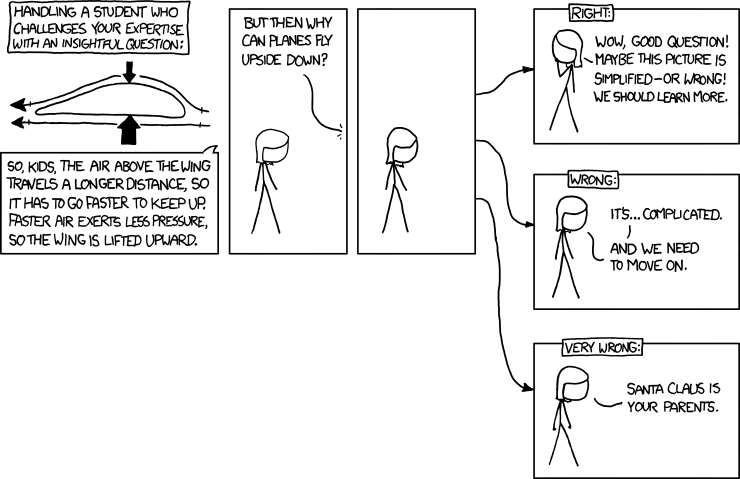
The cartoon is, of course, xkcd.


READ MORE - Faith and fear

On balance


Theology alert--feel free to jump in....
This was inspired by Father Sean and Brother John and Reverend Scott.


Balance.

We need balance in our lives. Overwhelmed? Seek balance.

An innocuous philosophy--who could possibly be against balance?

A madman in the back wildy waves hand--and (again) I get sent out of the classroom.


***

The light is failing. Local carbon dioxide levels will rise until late May now, when resurrected plants start reconstructing the molecules back into something we can use again next winter. CO2 and H2O, carefully bonded back together into strawberries in June, peaches in July, corn in August, wheat in the September...little left now but the kale and the Brussels sprouts.


Breathe on your hand--you can feel the moisture, the breeze of molecules brushing your hand.

If God can be found, She will be found in the chloroplast, Her heart made of rubisco, the enzyme that puts us together, the most common protein in our known universe. She carefully holds a tiny molecule of carbon dioxide, three atoms of nothing, and glues them to life.
Heart of God?


She takes her life, her energy from the sun. Three times a second, another molecule of CO2 pressed together to a molecule of life, over and over and over again.


Rubisco is everywhere, in every green leaf, and as the leaves of summer fade into fall's glory, She leaves us. We start to drown in our own CO2, waiting for Her return, as She has, as She will. (That's called faith.)
***

You cannot balance a lifetime. You can dance, jump for joy, cringe in fear, curl up, scream, love or hate. There is no balance for love, for fear.

A well lived life is not one where you've balanced your fears with your joys, your love with your hate.

A "well lived" life makes no sense. You cannot "lived"--you can only live, now, this moment. Either the amygdala or the cortex rules a moment. We pretend we can string together moments, we hold on to memories, to words, to pictures, to myths of eternity, and we miss the obvious.

The here and now.

And we wonder why it's hard to teach children in a classroom....

***

A couple of soldier flies erupted from our class terrarium last week. Unexpected. Large critters crawled out of the thin litter layering the glass bottom. The yellow bar splashed on their legs with their waspish wings and fluttering antennae screamed danger. My cortex knows they're harmless, my amygdala makes my fingers stutter when I pick one up.

The last few days a half dozen more came from the same dirt.

When I opened the top to feed my sowbugs yesterday, two flew out and headed for the window. They only live a day or two as adults, and they had been trapped for hours in the terrarium. They flew fiercely, full of desire, and crashed right into the glass.

Instinct, true. Fixed action patterns with proximate and ultimate causes. Memorize this, children, pay $87, and earn your AP Biology credit.

We never speak of desire in other creatures. Of wants. Of needs.

The soldier fly carcasses will sit on the sill until my students return on Monday. I will ask them how they got there. Then I will ask why.

We all need what rubisco gets us--we all feel desire. It's why we burn our energy even though we know December's coming.
***

וייצר יהוה אלהים את האדם עפר מן האדמה ויפח באפיו נשמת חיים ויהי האדם לנפש חיה׃
And the LORD God formed man of the dust of the ground,
and breathed into his nostrils the breath of life;
and man became a living soul.

We think we're sophisticated and learned and (the worst conceit of the three) immortal. We gorge on the fruit of the Tree of Knowledge and forget that we are closer to the soldier flies than we are to rubisco.

I do not know who wrote the Hebrew Bible, and I do not know which of the 47 men chosen by King James translated Genesis 2:7, but there's been a huge misinterpretation of "soul" in the last few hundred years.


The soul, at least according to the Words allegedly governing the actions of the dangerously powerful here in the States, is not separate from the dirt. Our "stuff," the polymers of proteins, our layers of lipids, our DNA, our essence, is our soul.

We are mortal and finite. We are living souls, dependent on rubisco, dependent on unimaginable events in the heart of the sun, hydrogen to fusion, mass to light.

You want your children ready for the world of humans, raise them under artificial light. Keep them planted in front of monitors. Feed them impossibly perfect fruit. Keep them shod. Pump them full of music made by machines. Surround them with images of the "perfect" human, and demand they become one.

Don't talk to me about balance.

We are training our children to avoid the window pane, to stay safe, to gaze at the world outside, to create stronger panes. We don't want to see them hurt. We cannot imagine their last agonal breaths.

Me? I want my children to crash into the glass, and if they're bloodied lying on the sill, to get up and crash into it again. Again and again and again.

3 billion years of desire got us to here; a few hundred years of playing God has reduced us chasing photons on screens, practicing religion disconnected from the wiser elders who wrote texts we refuse to read, to believing we are in control.

I may be unhinged, but I am not as unbalanced as anyone who believes in balance.

The sun that sustains me has been dropping lower into the sky day by day, the plants that feed me have lost their leaves, the bees I adore have gone. I am a man of science, I have a good idea why this is so.

I am also a man of faith--faith that the sunlight will return, and that rubisco will return with it come spring.


Photos are mine and Leslie's.
The rubisco model is from Wikipedia, and is in the public domain.
READ MORE - On balance

This puts essential questions in perspective

"The higher quality data available since 1950 has allowed the team to calculate that since that time, the world has seen a phytoplankton decline of about 40%."


Uh-oh....

"Phyto-" means plant. Phytoplankton, like all green plants, take in more carbon dioxide than they produce, and release more oxygen than they use.

Phytoplankton produce about half the oxygen available to us.

We have plenty of oxygen, so we're not in Spaceballs territory yet (remember Megamaid?), but if this trend plays out, we are screwed.

So how about this for an essential question? Which organisms depend on phytoplankton to survive?

Yep, we're on that list, too.


"Megamaid" picture is obviously from Spaceballs, and taken from here.
READ MORE - This puts essential questions in perspective

Bloomfield's sidewalk astronomers catch a galaxy

I advise the Bloomfield High School Astronomy Club--we are sidewalk warriors, fighting the glare of streetlights, security beacons, and gaudy church steeples. A few times each night flashing emergency lights roar past us a few feet away.

We live under 3 runway lengths from Newark Liberty International Airport. (To be fair, runway 4L/22R is about two miles long.) One of our games is called "catch the plane"--students attempt to get the plane in the telescope's field of view, not as easy as it sounds when you're just a few miles from the airport.

I get a handful of kids every clear Tuesday night, chasing Jupiter and the few stars we can see naked eye. Even with the light pollution, though, a peek through an 8" scope changes their view of their universe.

We finally caught the Andromeda Galaxy a few days ago, using an 8" telescope on a manual mount. We have a computerized mount somewhere, but I keep pretending I don't know how to use it. The budding astronomers are getting to know the sky the old-fashioned way, which is to say, they are getting to know the sky.
***

I've been covering cell energetics the past few weeks. How does life get its energy, its "stuff"? I have a time-line in the classroom, a meter for ever billion years.

(OK, the time-line stops at 4.5 billion years ago, just short of Earth's birthday, but I've swept along the imaginary portion of the time-line so many times I'd bet you'd get a dozen kids to testify times that we have a time-line that goes back 14 billion years or so. I really need to get another roll of paper.)


I start at the beginning. I call it our creation story, and it is a story. It has a name--Big Bang model. I'm careful not to call it a theory.

How do we know, Dr. D?
Well, we know this much. The visible galaxies around us keep going farther and farther away. Where will they be next week?
Farther.... (It's amazing to hear kids roll their eyes with their voices)
Where were they last week?
Well, doh, closer
Last year?
A thousand years ago?
A billion years ago?

And they get it, at least they get the impetus for the model. It's our creation story.

I speak carefully, but the words are the right ones--it is a creation story. It's a model. It's a good one, but by acknowledging that we cannot know as a fact (apparently the gold standard in sophomore debate) the origins of our universe keeps their own creation myths safe.

For most of my students, Genesis is the myth they believe in, but most of them could tell you as much about Genesis as they could the Big Bang model. I've taught both, but never in the same place. They're both useful stories. They're both human stories.

Neither explains why an apple tastes so good.
***

The Andromeda galaxy is the only object beyond our galaxy we can see naked eye.

First time I saw it without glass was a week before Hallowe'en, many years ago, right after we took our two youngsters on a haunted hay ride in the Jersey skylands. It hung out there even beyond the stars, a puff of fine mist hovering beyond my known universe.

You will not see Andromeda without a scope in Bloomfield.

When we did find it, we saw an oval smudge. I worried that the kids may feel let down, and started to pontificate about how long it took the light to go from that smudge to our eyes.

I should have stayed quiet--they thought it was cool. They kept going back to look at it.

Besides, turns out I couldn't remember exactly how far the galaxy is--I thought it was a bit over 3 million light years away, but the experts changed their minds and calculated it to be "only" 2.5 million light years away.

And that's the point.

My grandfather was in his late 20's before Edwin Hubble convinced other astronomers that these blobs of stars lay outside our own galaxy. That wasn't so long ago.

And it's hubris to think any of us can know the difference between 2.5 and 3.2 million light years.

***

Cosmology rests on light. Cosmologists study light in its various forms, but unlike biologists, have no need for their noses, for their skin. Cosmologists work with the intangible.

Our modern creation story has been written by a very few men with very big brains who trust their eyes more than their tongues. It is thus written.

The Big Bang model, like Genesis, is ultimately incomprehensible. It's important that my kids know this, at least about the cosmological models. I leave Genesis to their parents.

Once science becomes known "as a fact", once it becomes frozen in mythology, it becomes useless.

Even worse, it becomes boring.
READ MORE - Bloomfield's sidewalk astronomers catch a galaxy

Puddles

I am going away for a couple of weeks, to wander around the west coast of Ireland. Perhaps the journey will cure my delusions that my rants will have any effects on the US DOE. Should I decide to spend the rest of my life on the Aran Islands, I do not want my last post to be about Arne.

I am lifting this from something I wrote over 5 years ago, late June, 2004. I was still in medicine at the time.


Children gravitate to puddles.

Children see things before they are taught they do not exist.1 With enough education, they learn to avoid puddles. They no longer waste time staring at the edge of a pond.


My daughter, now old enough to have children of her own, still whiles away time at the edge of water. Yesterday we wasted some time on a warm June evening staring into a 15 gallon bucket of pond water, kept by the garden for watering plants. She did this partly to keep me company, but mostly because she wanted to. On the days I am sure I screwed up as a parent, I need to remember this.


If you stare at the night sky long enough,more details emerge. A hundred stars turns into a thousand. If you hold a handful of pond water, you might not see anything at first. Look a little harder. Look for movement. It's there.


I shelled peas today, something I love to do. I split the impossibly green pod, then run my thumb inside, freeing the peas. Some bounce away onto the ground, looking to snuggle into the earth. I leave them be.


Shelling peas is supposed to be tedious--it's one reason Americans wanted to get off the farm, I suppose.

But just stop for a minute and think about what it means to live in a land where 95% of the people can be freed from, the drudgery of preparing their own food.

James E. Bostic, Jr
Assistant Secretary of [Agriculture] for Rural Development2


I enjoy shelling peas. My father, not much older than me, cannot shell peas anymore. Not sure he ever enjoyed it when he could, but he would today. He still enjoys eating them, though he turns blue now and again when eating things pea-sized. June is pea season. It is my father's last pea season.


Desire is a funny thing.


Our family microscope is a teaching scope--Kerry and I can look at another world together. When one wanders away from one's usual world, it's good to have company.


We stared into the same world together.


The critter peeked from under a duckweed leaf, saw an even tinier critter, and munched. It moved, well, gleefully.


I am, of course, anthropomorphizing....but gleeful is the right word. We can reduce it to the transfer of energy from one critter to another, but the subsequent burst of energy gave me a burst of energy--glee is contagious.


Turns out the critter was an ostracod. I never saw an ostracod before. I never thought about them when I used pond water to feed the garden. I knew that pond water made great fertilizer. I just never wondered why. "Glee" (or energy) gets transformed into plant growth. Which means ostracods die.


Ostracods have sex. Ostracods eat. Ostracods have baby ostracods.


Boy ostracods attract girl ostracods by using flashing lights. Boy ostracods use "a special long leg" to pass sperm into girl ostracods. I bet a boy ostracod enjoys his "special long leg."3


Watering my plants just got harder.


In the 17th century, Antonie van Leeuwenhoek made microscopes. Invented them, really. He saw things no one saw before.


I then most always saw, with great wonder, that in the said matter there were many very little living animalcules, very prettily a-moving. The biggest sort... had a very strong and swift motion, and shot through the water (or spittle) like a pike does through the water. The second sort...oft-times spun round like a top...and these were far more in number.

Antony van Leeuwenhoek, in report to the Royal Society


I cannot imagine the wonder coursing through Leeuwenhoek's veins, but I know what I felt as I sat with my eldest on the stoop, seeing critters we never imagined. We did not know they were ostracods yet. We did not know much about them at all.

We knew this much, though--they got excited when they found something good to eat. We could see them munch on something else, then could see the "something else" in their bellies. Voyeurs, we were.

This is the world we live in. You have innumerable critters in your gut, in your nose, on your skin. You are surrounded by a cloud of bacteria. Every step you take destroys uncountable lives, but creates ground ripe for uncountable more.

We think we are special, and perhaps we are.


Yearning. Lust. Desire. I seek light, warmth, food, and love. So do animalcules. In June, with the infinite light of early summer, it makes sense.


1When I was young, I believed what they taught me--at noon, the sun was supposed to be directly overhead. I spent years studying shadows at noon, years, before I realized that I had been fed a lie. In this part off the world, the sun is never directly overhead.

2 From The Unsettling of America, in " The Body and the Earth," Wendell Berry, p. 96.

3Antony van Leeuwenhoek (1632-1723), http://www.ucmp.berkeley.edu/history/leeuwenhoek.html


The photomicrograph is by Anna33 via wikimedia, released under Creative Commons.


READ MORE - Puddles

Arne Duncan, meet the Declaration of Independence


“The best thing we can do is educate our way to a better economy."
Arne

I try to keep catechism out of my classroom, and not just the Christian sort. If you think you can learn science from a textbook, or from an interactive computer program, or from packaged lab activities, you are teaching catechism.

I also try to keep religion out of my classroom, but pushing the limits of what we know can lead to "dangerous" thoughts among my tadpoles.

"You're competing for jobs with kids from India and China. Schools should be open six, seven days a week; eleven, twelve months a year."
Arne again, talking to students in Denver

Perhaps Arne did not pay attention during biology classes. Or maybe he did. It is quite possible to ace an introductory level biology course without understanding much.

The Earth teems with life; life teems with energy. Our existence depends on the flow of energy through organisms--that's why we eat.

The Earth receives a finite amount of energy each finite moment, gifts from the sun. We are gulping up millions upon millions of years' worth of sunlight stored in fossil fuels, again finite.

We, as part of this teeming community dependent on the sun's light, have limits.

I am confident that we are on the right course as the Administration implements a comprehensive cradle-to-career education agenda to prepare our citizenry to compete in the global economy.
Yep, Arne

The religion of the global economy, however, does not recognize limits. "Economic growth" drives the world economy.

We cannot continue economic growth indefinitely--we are ultimately tied to the land. If I can teach one thing to a child, it would be that we came from the dust, and we shall return to the dust. Our cultural mistake, our cultural tragedy, is belittling the dust, and the energy that allows the dust to swirl and change forms.

Science only works when we seek to get beyond the world inside our heads. Grasping the world outside, however, depends on creating representational worlds inside our heads. Sadly, we confuse the latter with the natural (or the universe or reality or the mystery, or whatever word you choose to use--science cannot tell you what that great mystery is).

Thinking we can grow or exploit our way out of an economic crisis reveals a fundamental misunderstanding of basic biology.

Community colleges like Miami Dade are going to be an extremely important part of restoring the economy over the next few years and ensuring that our students can compete not just with their neighbors down the block, but also with their peers in China and India.
Arne

I have a hypothesis:

Should we ever raise a generation of knowledgeable children, grounded in natural world, capable of thinking for themselves, not surrounded by the constant commercial hum defining success (money, bright teeth, money, large home, money, fast car, money, firm thighs, money, multiple degrees, money, executive privileges, money...) the gross domestic product would come crashing down.

That would be bad news for most of us in the States. We would lose a few digits in our electronic portfolios. Our tidy retirement funds set aside to provide us with the finest nursing home care might evaporate. We might not be able to travel far from our backyards.

On the plus side, such a generation could grow food, dress themselves, repair engines, darn socks, bake bread, build homes, unplug a toilet.

These investments [American Recovery and Reinvestment Act of 2009] are the surest way to provide long-term stability in to our economy. With these funds, we will educate our way to a stronger economy.
Arne again

The point of public education should be to promote a functional citizenry. And the point of government? Today's as good a day as any to ask. We got a pretty good answer to that question back in 1776.


We hold these truths to be self-evident, that all men are created equal, that they are endowed by their Creator with certain unalienable Rights, that among these are Life, Liberty and the pursuit of Happiness.--That to secure these rights, Governments are instituted among Men, deriving their just powers from the consent of the governed.


For all the talk of the economy, for all the talk of education, we've managed to screw up the intent of both. Arne is tying these two disastrous misadventures together, convinced he is serving a noble cause, and I cannot really blame the man--he is the epitome of what the best in education can produce today. He is not the only disaster produced the University of Chicago Laboratory Schools. His tragedy, his blindness, is ours. Few of us know what we want anymore.

So long as the sun shines, though, I remain an incorrigible optimist

Today is one of the few days Americans congregate outside. Children will chase lightning bugs as the adults will slap at mosquitoes. Just about everyone gets a chance to see the sun set.

It's a good world waiting for us outside our heads--and for a few wonderful hours, our culture will unplug itself and celebrate a country that still exists in our heads and in Norman Rockwell paintings, but that once existed for real.

It can happen again. It's why I teach.


READ MORE - Arne Duncan, meet the Declaration of Independence

Communion


Our neighbor's father died last night after a brief but ravaging illness.

The usual laughter rising over the fence has been missing the last few weeks, and I suspect it will be some time before it returns.

An earlier thunderstorm cleaned the air, as they do in Jersey, and the azure dusk sky marked the last few hours of June. My tiny pond was already wrapped in gray shadows, everything but the sky bled of color except for the occasional cool fire of a lightning bug.

The end of June marks the start of the dying of the light, punctuated by the mourning next door.

I turned to go back inside, then turned back again. I did not want June to end.

On top of the stockade fence separating our yards is a small platform I built a couple of years ago, a place for my potted plants to grab a little more light. (A maple tree keeps growing, and my garden now falls under its shade.)

A forgotten prickly pear sits in a cracked pot--I've had it for years, given to me by a friend I've not chatted with in a long while. After winter the plant looks dead, shriveled, and every year it surprises me.

I gazed up over the fence to catch the last blue light of the fading sky, and my eye caught a hint of yellow on top of the fence.

The prickly pear had flowered, first time ever.

I can hypothesize about the why. I can postulate that the extra light the cactus now gets triggered some photoperiodic phenomenom. I could look up some articles on the internet to sate my curiosity.

But I won't.

I know this much--an good man who has led a good life dies, and before the next sunset, a cactus that felt the vibrations of the man's voice bloomed.

I also know that the flesh of this cactus holds some of the carbon that once flowed in this man's blood--parts of the flower came from inside his mitochondria, in the deepest cells in his body when he still breathed.Literally.

I have my own private beliefs concerning this particular cactus blooming this particular hour.

It's easy to watch the symphony of life outside, as though we're not part of all this, as though we're special, immortal.

We are not.

I need to call the person who broke off the cactus pad years ago, plopped it on a pot, and assured me it would grow. June is almost gone. It's later than I realize.


Prickly pear photo by the EPA, 1972, in the public domain via the National Archives.
READ MORE - Communion