Breaking down biology

Thermodynamics started out as steam punk physics, but now explains, well, everything.

There is a non-trivial element of faith the the Second Law of Thermodynamics, one we dance around when we toss the idea of the Big Bang around in science class. Every time there's an energy exchange in a closed system there's less useful energy available to do work--and that's the natural world in a nutshell.

Everything eventually falls apart, drifts to a state of uselessness.


From The Onion,


If students spent any time delving into the implications of that, they'd go from the nutshell to the nuthouse. Instead we toss serious equations at them, with serious sounding names for all the serious parts, and we got them playing in abstract la-la land, which is a fine place to be in you've studied physics for years, but a psyche-killer for the neophytes.

How did the energy get packed into a point billions of years ago? We have a don't ask, don't tell policy.  That kids blithely except the concept of the universe contracted to a point just assures me no one's really paying attention.

My goal this year? Get them paying attention.


So here's my question for the more experienced out there. Would it be crazy to design the biology course around the Second Law of Thermodynamics, starting out each class every day with a brief discussion of how energy transformations guide everything in biology?

Evolution is the Big Daddy of Biology--should I spend as much time on Grandpa Entropy?


I'm not going to lie to you--first time I saw this photo I thought it was a real protest. Things have gotten that crazy.

Photo lifted from The Onion--where else?
READ MORE - Breaking down biology

Thermometers, yet again

If you stick your hand into a half full jar of sourdough pretzels in a Jersey July, you will feel your hand get noticeably cooler. Really. Try it.

If you measure the temperature inside the jar, it will be exactly the same as the temperature outside the jar. Any child with any sense and a respectable contempt for authority will tell you this. It's cooler in the jar!

It definitely feels cooler, yet the thermometer says otherwise. What's going on?

(Hint: this wouldn't work in Phoenix.)

Turns out experience is local. No national science curriculum can tolerate the very different results of my pretzel jar demo, a shame, really, because the children in Phoenix can very easily (and cheaply) discuss their results with the children in the humid halls of Bloomfield. Skype, blogs, wikis, heck, even phones.....

The humidity in the jar is much lower than the humidity in most of Jersey. Sodium chloride ("salt") is really good at grabbing water molecules from the air. The salt on the pretzels in the jar assures a low humidity environment, at least as long as you keep on the lid.

2nd graders do not need to know terms like "sodium chloride" or "hygroscopic." They should know, however, that science and intuition are not mates. They should know that science is based on what we call the "natural world" (itself a concept 2nd graders have a shot at grasping). They should know that science is testable.

I really don't give a rat's buttocks if a child can convert Celsius into Fahrenheit--that kind of skill matters, true, but that's not science, and it's something I can easily teach. I do care if a child is curious enough to wonder why her hand feels cool in a bucket of Snyder's Sourdough Specials.


Good Lord, I need curious children.We all do.
READ MORE - Thermometers, yet again

Thermodynamics in elementary school

The cicadas are humming again. I think I hear what they're saying: "As much sun as there is today, there's a little less than yesterday." They crawl form underground chambers to share their oracles, our oracles. We know how the story ends.


The easy living of early June gives way to the inevitable entropy that follows. You can smell the still subtle fragrance of decay today, soon to be mixed with the sulfury celebration of our country. The Fourth of July is our nation's midsummer night of madness.

We are already harvesting for the winter.
***

Something happened a long time ago. That's how most stories start.

In science, whatever that something was, it was big, and "a long time ago" was just that--an incomprehensibly huge chunk of time between when the "something happened" and now.

If you don't keep that in mind, the story of science, as we know it now (and it will, of course, change), cannot hold.

It all boils down to the Laws of Thermodynamics. The laws are, in a sense, religious, not a trivial point.

Energy/mass cannot be created nor destroyed--we have what we have. Call mass/energy some random string of sounds--let's call it the Great Hedasha--and you found a sect.

The Great Hedasha is all. She cannot be destroyed, only transformed. She is part of everything in existence--she changes forms, but is always whole. The Great Hedasha, as she transforms, loses structure, loses form, becomes more amorphous with every passing moment. She becomes less useful (and "useful" is a huge word). Entropy rules.

Amen.

Unless, of course, she reverts to whatever She was 14 billion years ago or so--maybe the Hindus got that right. No way to know, of course.
***

Science is allusory--we need reference points to make it work. Allude means, literally, "to play with." Science plays with reality, creates stories that then bend back our perception of reality, then plays some more. The natural world, for all our confusion, is remarkably consistent.

When we teach science as reality, we kill it. When we take the play out of thinking, we lose whole universes. It is possible to engineer a better bridge without knowing a whole lot of science.

We may or may not need more engineers, depending on who you talk to--but we could use more science in our early grades.We teach a lot of pseudo-science. We expect kids to believe that the Earth is round, because we say so, that gravity sticks them to the "side" of the Earth because we say so, that the universe is billions of years old, because we say so.

None of those is easily demonstrated in a classroom--but entropy is. Things fall apart. It takes "energy" to put them back together.
 ***


How do we teach entropy? We mostly don't.

While the concepts are, at the heart, simple, the ramifications are huge, and involve things most of us would rather avoid--death, nothingness, everythingness, ommm, ommmm, ommmm.

We dabble with it in high school physics, but couch it in equations, and solving the equations, alas, becomes "science."


Obviously we're not going to toss calculus at kindergarteners. (Even Achieve.org is not that opaque--yet.) But we can still teach thermodynamics.


Things ultimately get cooler. Always. The seeming exceptions are when we warm things up by adding energy to smaller systems within larger ones.

We exist as our prideful orderly selves because the sun keeps streaming onto our planet. When the sun creeps away, as it does every year, things fall apart. Why? Because useful energy scatters, and has for billions of years.

That's about as far into the why you can expect from a young child, which is OK, but that's as far into the why as you can expect from a nuclear physicist.

Humpty Dumpty is all about entropy. As is science. As is life.


Kids know this already. We older folk often forget.


The cicada image is by Gardener41, used under CC
Humpty Dumpty is from Alice in Wonderland
The equations are from Statistical Geofluid Mechanics blog by  
READ MORE - Thermodynamics in elementary school

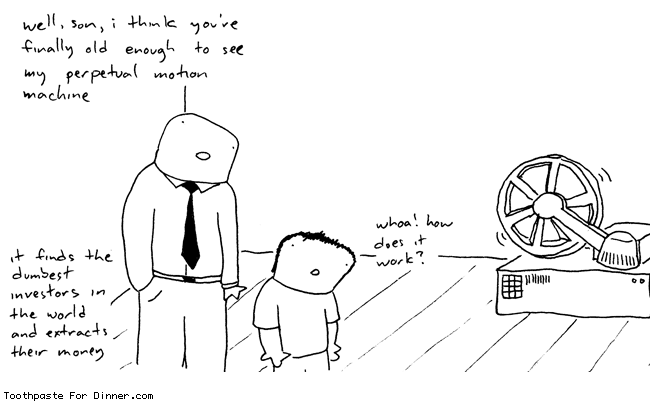
Perpetual motion machine


I've been having fun with an idea for a perpetual motion machine that popped into my head at 4 AM. I dreamed it, woke up, remembered it, and now I'm playing with it.

Yes, I know it's impossible, but I've yet to crack the error--yes, I know I'm missing something--but until I figure out the mistake, I'm keeping (mostly) quiet.

Just in case.

Addendum: here it is. The green represents 1 M sucrose solution, the blue pure water. The hatched lines represent semipermeable membranes.

The water has bulk flow into the sucrose solution, then exits via the membrane at the top of the left tube.


Shoot, wrong again....just figured out why.
I will post up my egregious attempt to defy the gods later, after I've tossed it around class.
Yes, of course we're going to try it anyway--this is SCIENCE!

The first image was drawn by the Robert Boyle; I'm proud to say my idea was similar, as you will see.

Toothpaste For Dinner is, well, Toothpaste For Dinner--don't miss it.

READ MORE - Perpetual motion machine